 Francesco Chiaramonte
To plan a tattoo sleeve, pick one theme and one style, decide how far the sleeve will run (half or full), find an artist who has healed sleeves in that style, and agree on a budget and session plan before the first stencil goes on. In 2026 a half sleeve usually costs $600 to $3,000 and a full sleeve $1,500 to $6,000 or more, spread over several sessions and often 6 to 18 months (Tommy's Supplies, 2026; TattooStudioPro, 2026).
A sleeve is one large composition that wraps around a rotating, bending arm. Most problems I see come from planning it as a list of separate tattoos. This guide walks through the decisions in the order that saves the most money and regret: theme, budget, artist, design, sessions, healing, and long-term care.
What Is a Tattoo Sleeve?
A sleeve is a large tattoo, or a connected group of tattoos, that covers most or all of an arm (or a leg) the way a shirt sleeve would. What separates a sleeve from "a lot of tattoos on one arm" is that it was designed as one piece.
Types of Sleeves
| Type | Coverage | Typical cost (2026) | Typical sessions |
|---|---|---|---|
| Quarter sleeve | Shoulder cap to mid upper arm, or forearm only | About $400 to $1,500 for a forearm or quarter-sleeve piece from a mid-level artist (Tommy's Supplies, 2026) | 1 to 3 |
| Half sleeve | Shoulder to elbow, or elbow to wrist | $500 to $1,800 mid-level, $3,000 to $5,000 for dense color or realism | 2 to 3 |
| Three-quarter sleeve | Shoulder to just below the elbow, or wrist to above the elbow | Between half and full sleeve prices | 3 to 6 |
| Full sleeve | Shoulder to wrist | $1,500 to $6,000 or more | 4 to 8 |
| Leg sleeve | Hip to ankle, or a shorter thigh or calf version | Usually higher than an arm sleeve, because the surface is larger | More than an arm |
Costs and session counts come from TattooStudioPro, 2026 and Tommy's Supplies unless marked otherwise. The three-quarter and leg rows are my own planning categories, so get a quote for them instead of relying on a range. Jeremy Furniss points out that people underestimate leg sleeves: a leg is a much bigger canvas than an arm, so expect more sessions and larger pieces (Jeremy Furniss Tattoo).
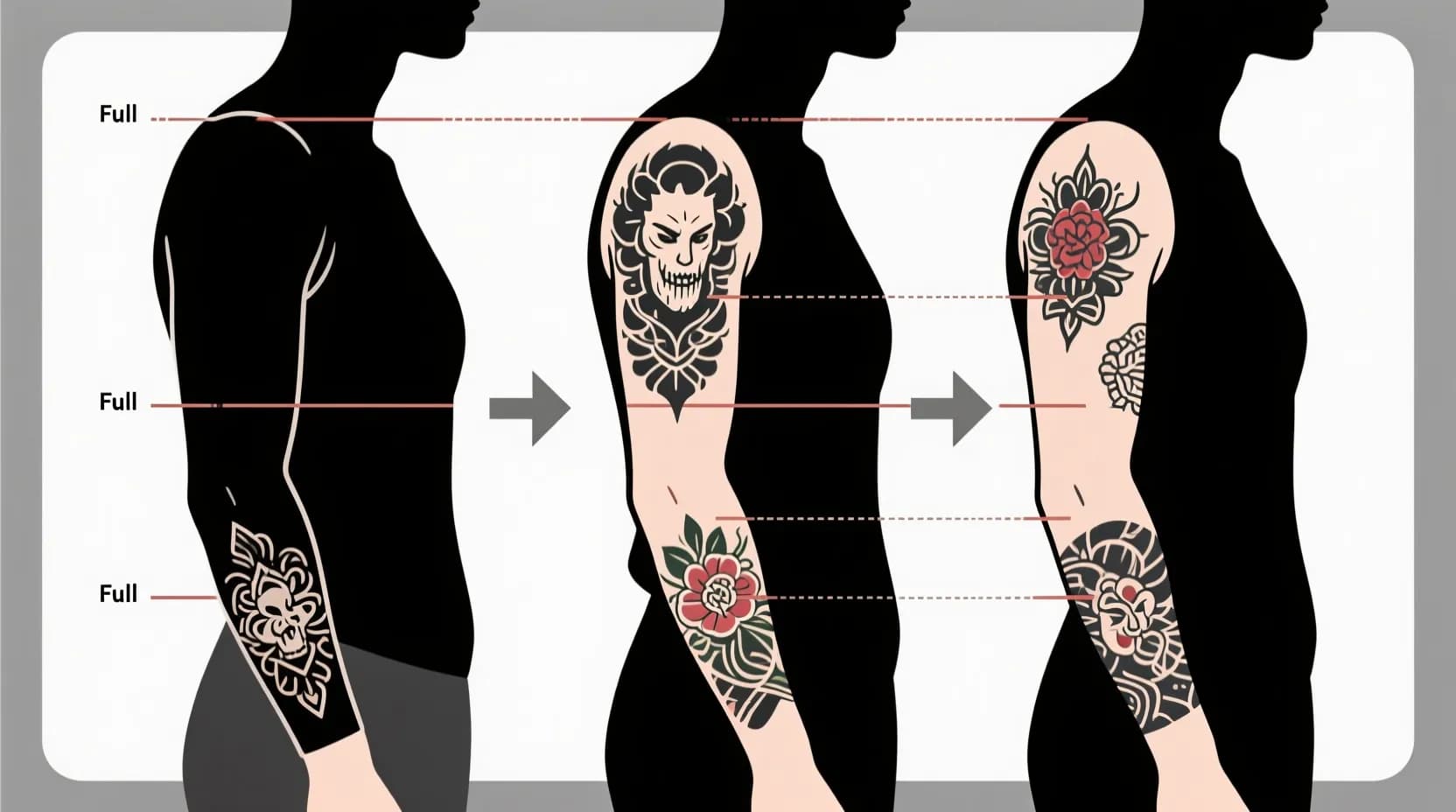 Different types of tattoo sleeves showing full half and three-quarter coverage
Sleeve vs. Collection of Tattoos
A sleeve is designed as a unified piece. A collection is a set of individual tattoos that share a limb. Both are valid, but they are planned differently.
A sleeve usually has:
- Background elements that tie subjects together (smoke, waves, clouds, ornament)
- One color palette, or consistent black and grey
- Flow that follows the muscles and the way the arm turns
- Negative space used on purpose
- Transitions between subjects
A collection usually has:
- Separate backgrounds and sizes
- Mixed styles
- Gaps of bare skin between pieces
- No shared element that connects them
If you want a sleeve, plan it as one from the first tattoo. Turning a collection into a sleeve later means cover-ups, fading, or filler work. A "patchwork" sleeve is a valid middle path: separate pieces chosen on purpose, joined by a consistent palette, tone, or line weight (TattooStudioPro).
The Sleeve Design Rules That Matter
Competitors list 15 "rules" for sleeves. Most of them reduce to six, and I would check any plan against these before paying a deposit.
- One theme. A theme is the idea that makes unrelated images belong together. Furniss recommends keeping the whole sleeve in one theme (his example is Greek gods) or at least using subjects that contrast well, such as skulls and roses (Jeremy Furniss Tattoo). A tattoo artist quoted by Stories & Ink says a theme helps ideas "click together", and that a tropical fish, a blue tit and roses will jar (Stories & Ink, 2023).
- Hierarchy. Decide the primary subject, the supporting elements, and the background before anything is drawn. If every area has the same level of detail, the sleeve becomes visually heavy (Ultimate Tattoo Supply, Feb 2026).
- Background and filler. Smoke, clouds, waves, ornament, and small fillers connect the main subjects. Plan them in the first design, not after the "cool parts" are done.
- Flow with the muscles. The arm is not a poster. It rotates, bends, and compresses, so artists design around the deltoid cap, the outer forearm, the elbow, and the wrist taper (Ultimate Tattoo Supply, Feb 2026). Furniss gives a blunt example: a face placed in the wrong spot over a muscle can end up looking cross-eyed.
- Negative space. Skin left open gives the eye a rest and keeps detail from turning muddy over the years. Use strong contrast between light and dark, and avoid heavy mid-tone shading and micro-detail everywhere.
- One consistent style. Style drift is a common reason sleeves fall apart. Fix line weight, shading method, color or black and grey, and background treatment before the first session (Ultimate Tattoo Supply, Feb 2026).
A practical cap on subjects also helps. One planning guide cited by Think Tank Tattoo suggests dividing the arm into four main sections with roughly four to five main subjects, so the sleeve stays readable (Think Tank Tattoo, 2026).
Step 1: Define Your Vision Before You Talk to Any Artist
Walking into a shop and saying "I want a sleeve" is like asking an architect for "a house". Settle these decisions first.
Choose Your Style
Style drives which artists you consider, how long the sleeve takes, what it costs, and how it ages. Common sleeve styles:
| Style | Typical features | Planning notes |
|---|---|---|
| Japanese (irezumi) | Koi, dragons, tigers, waves, wind bars, peonies | Flowing composition, bold outlines, large background areas (waves, clouds). Works well as a connected sleeve. |
| American traditional | Eagles, ships, roses, daggers, pin-ups | Bold black outlines and a limited palette. Individual pieces can be placed with fillers between them. |
| Black and grey realism | Portraits, nature scenes, religious imagery | Smooth shading, no outlines. Needs long sessions and an artist with healed realism sleeves. |
| Geometric and mandala | Patterns, sacred geometry, dotwork | Precise linework that often wraps around the arm. Straight lines show errors, so check healed work. |
| Neo-traditional | Bold subjects with richer color and ornament | Illustrative look with more detail than traditional. |
| Trash polka | Realistic and abstract elements, usually black and red | Collage-like and loose, but still needs a plan for balance. |
| Blackwork and illustrative | Heavy black fill, engraving-style linework | Strong contrast, good for covering old tattoos. |
Not sure which fits you? Our guide to tattoo styles for AI generation shows what each style looks like and what words describe it.
Pick a Theme
Think of the theme as the sentence your sleeve says. It can be a story (a life timeline), a culture (Japanese myth), a subject (ocean life), a mood, or just a consistent look. TattooStudioPro notes that a theme is not strictly required: unrelated subjects can still work together if you keep a consistent palette, tone, line weight, or illustration style (TattooStudioPro). The point is that something ties the sleeve together.
The next section has 20 theme starting points. If none fit, write the sleeve as one sentence ("a storm over the sea that clears toward the wrist") and show that sentence to the artist.
Color or Black and Grey
This choice changes which artists you can consider, the cost, and how the sleeve ages.
- Black and grey ages predictably, works on all skin tones, and is generally cheaper.
- Color is more striking when fresh but usually takes more sessions and product. TattooStudioPro estimates 20 to 40 percent more than an equivalent black and grey piece (TattooStudioPro, 2026). Saturated color also fades differently and may need color refreshes.
20 Sleeve Theme Ideas
Use these as seeds, not finished plans. Each one works as a connected sleeve if you add a background (smoke, waves, ornament) and keep the style consistent.
- Japanese koi and waves. A koi climbing toward the shoulder through water and wind bars.
- Dragon and clouds. One long dragon winding from wrist to shoulder.
- Greek mythology. Statues, gods, and columns in black and grey.
- Norse and Viking. Runes, knotwork, ships, and wolves. Stories & Ink lists Viking history as a sleeve theme (Stories & Ink, 2023).
- Animal sleeve. A lion, wolf, or bear as the focal point, with smaller animals in the supporting areas.
- Botanical and floral. Peonies, roses, and ferns, in color or blackwork.
- Ocean life. Octopus, whale, waves, and shells, with water as the background.
- Space and astronomy. Planets, constellations, and moon phases.
- Mechanical and biomechanical. Gears and cables that look like they run under the skin.
- Memorial and family. Portraits, birth flowers, dates, and symbols, as in our memorial tattoo guide.
- Landscape. Mountains, forest, and a night sky that continue around the arm.
- Skulls and roses. A classic contrast pairing that Furniss names as a safe contrast theme.
- Ornamental and mandala. Lace, filigree, and mandalas that wrap with the elbow.
- Horror and gothic. Cathedrals, ravens, and old illustration.
- Pop culture. Films, comics, or games. Stories & Ink lists Disney and Marvel sleeves among its ideas (Stories & Ink, 2023).
- Anime and manga. A character series linked by clouds or panels.
- Egyptian. Hieroglyphs, deities, and desert architecture.
- Religious or spiritual imagery. Saints, symbols, and architectural details.
- Travel and heritage. Landmarks and plants from the places that shaped you.
- Abstract and linework. Flowing shapes, fine lines, and negative space with no literal subject.
For more ideas by style, browse the tattoo ideas gallery.
Step 2: Budget Realistically
Under-budgeting leads to half-finished sleeves, compromises on artist quality, or stress that ruins the experience. Plan for the whole sleeve, not the first session.
Sleeve Cost and Session Table
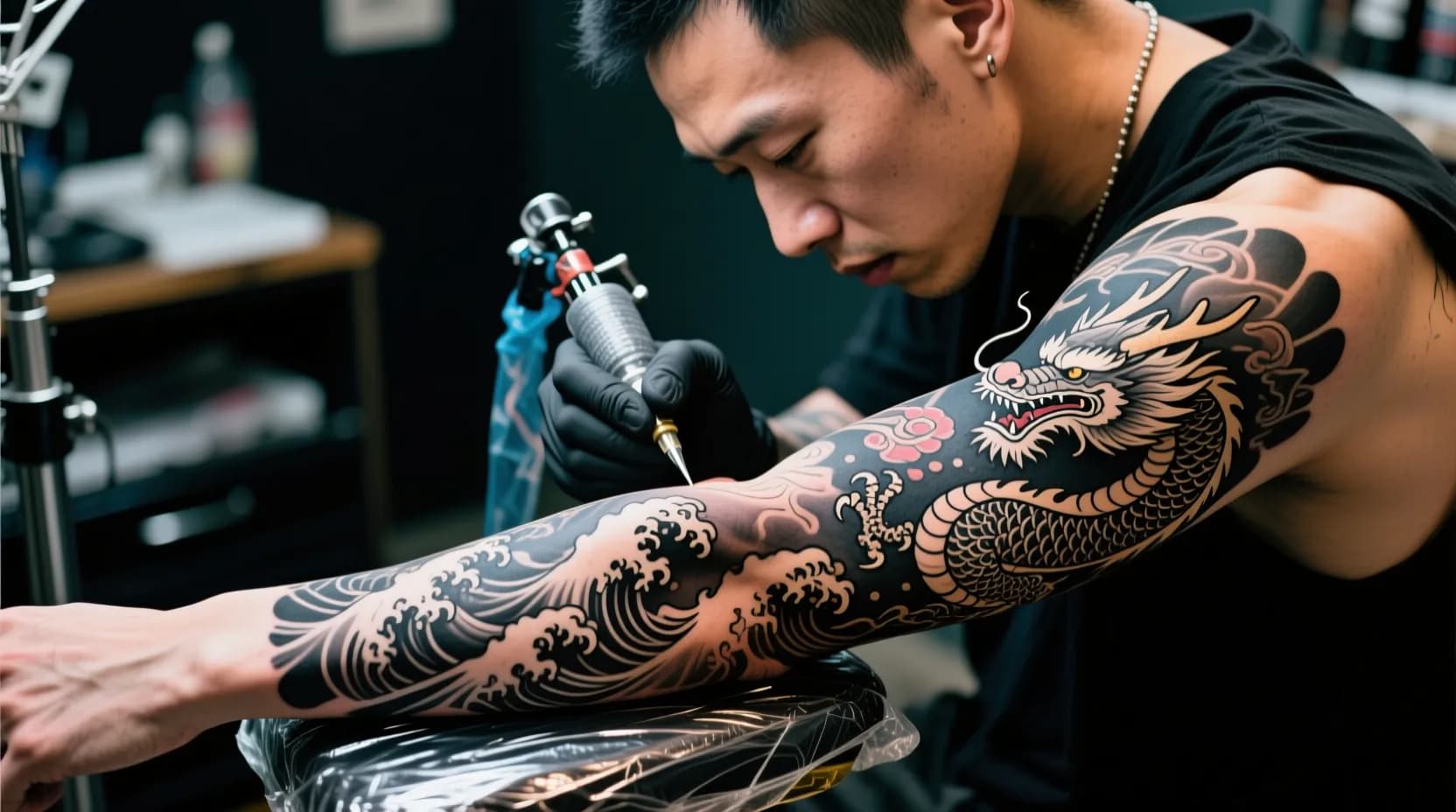 Tattoo artist working on detailed sleeve design
| Sleeve | Typical total cost (2026) | Typical sessions | What changes the price |
|---|---|---|---|
| Half sleeve, simpler design or mid-level artist | $500 to $1,800 | 2 to 3 sessions, about $600 to $800 each | Style, color, artist level |
| Half sleeve, dense color or realism, senior artist | $3,000 to $5,000 | Several sessions | Detail and hours |
| Full sleeve, patchwork over time | $1,500 to $2,500 | Spread over years | Separate pieces, mixed artists |
| Full sleeve, cohesive and detailed | $4,000 to $6,000 or more | 4 to 8 sessions over 6 to 18 months | Artist demand, hours, color |
| Full color sleeve, top artist in a big city | Can reach well above $10,000 | 6 to 8 sessions | Location, reputation (Art Collector Tattoo, Oct 2026 quotes $12,000 to $20,000 at one Los Angeles studio) |
Sources: TattooStudioPro, 2026, Tommy's Supplies, 2026. In the UK, Stories & Ink gives a range of £1,000 to £5,000 for a full sleeve, with up to three days of artist time spread over several sessions (Stories & Ink, 2023).
How Artists Charge
- By the hour. TattooStudioPro puts typical rates at $100 to $300 per hour, with major metro areas at $150 to $300 and smaller markets at $80 to $130 (TattooStudioPro, 2026).
- By the day. For sleeves, some artists charge a day rate covering a six to eight hour session, typically $800 to $2,000 in 2026 (Tommy's Supplies, 2026).
- By the piece. Common for patchwork sleeves where each piece is separate.
Ask which model applies. An experienced artist at a higher hourly rate who works faster is not automatically more expensive than a cheaper, slower one, so compare the estimated total hours, not only the rate. For a deeper breakdown by size and body part, see how much a tattoo costs, or use the Tattoo Price Calculator for a rough estimate of your own project.
Hidden Costs to Plan For
- Deposits. TattooStudioPro says artists typically ask $50 to $200 per session as a non-refundable deposit that applies to the final cost (TattooStudioPro, 2026).
- Tips. Budget a tip for every session. See how much to tip your tattoo artist for current norms, then apply them across the whole project.
- Aftercare products. Fragrance-free soap, a recommended ointment or lotion, and a protective film if your artist uses it. Our aftercare product guide helps you choose.
- Travel. If your artist is not local, count flights, hotels, and meals for every trip.
- Touch-ups. Ask whether the artist includes a free touch-up window and for how long.
- Time off work. Heavy friction and sweat in the first days can make physical jobs harder.
Payment Strategies
- Save first. Aim for roughly 125 percent of the estimate. That buffer covers overruns and tips, and means you can pause without stress.
- Payment plans. Some shops offer plans for large projects. Ask during the consultation.
- Session by session. Flexible, but risky if finances tighten and gaps stretch.
Furniss recommends holding off until you can afford back-to-back sessions rather than doing a sleeve "in dribs and drabs", because it is more efficient (Jeremy Furniss Tattoo). He also warns that a long gap, a year or two, means earlier work will have faded and the artist may need to go over it again to match.
Step 3: Find the Right Artist
A sleeve is too large, expensive, and permanent to give to whoever has an opening. Think Tank Tattoo makes a good point: you want to see whether the artist can control flow, scale, transitions, and consistency across a large area, not only whether single tattoos look good (Think Tank Tattoo, 2026).
What to Look For
- Style specialization. Choose an artist whose portfolio is full of your style, not "everything".
- Healed sleeves. Look for healed photos, not only fresh work. Check elbows, inner arm transitions, and how one major element leads into the next.
- Consistency. Clean linework, smooth gradients, and solid saturation across large areas.
- Skin tone experience. This matters most for color work.
- Professionalism. Licensed, clean shop, clear communication on process and price, no pressure tactics.
Where to Find Artists
Instagram is the main portfolio platform for most artists, so search the style plus your city and check Stories for healed photos. Shop websites, tattoo conventions (where you can meet artists from other cities), and referrals from people with sleeves you admire all work. Our tattoo shops directory is another starting point.
Red Flags
- A portfolio with only small tattoos or only fresh photos
- Prices far below the market without an explanation
- Willingness to copy another artist's custom sleeve
- Pushing you into their style instead of listening
- No questions about your lifestyle, skin, or existing tattoos
- Poor reviews about hygiene or communication
Consultation Questions
Most artists offer a consultation. Bring 5 to 10 reference images showing the style, the elements you want, the composition, and what you do not want. Then ask:
- What is your experience with sleeves in this style, and can I see healed examples?
- How do you plan for arm movement and different viewing angles? Experienced artists photograph and measure the arm, mark landmarks like the shoulder cap and elbow, and build a full map before stenciling, according to the Evolve Tattoo Collective article that Think Tank Tattoo cites (Think Tank Tattoo, 2026).
- How many hours do you estimate, and what is your rate or day rate?
- Will I see a design before the first session, and how are revisions handled?
- What is the deposit, and what is your rescheduling policy?
- Do you include touch-ups, and for how long?
- Do you plan the entire sleeve first or build it from a mapped framework?
Listen for honest pushback. If an artist never says no to an idea, you may be getting agreement instead of guidance. Ultimate Tattoo Supply also advises artists to be direct about hours, because underestimating hours to win a booking creates problems mid-project (Ultimate Tattoo Supply, Feb 2026).
Should one artist do the whole sleeve? Stories & Ink says it is your choice. One artist gives the most consistent look, while collecting from several artists makes a patchwork (Stories & Ink, 2023). If you use several, agree on palette and line weight up front, and have the artists talk to each other (TattooStudioPro).
Step 4: Design Your Sleeve
You can design in three ways, and most people mix them.
Artist-Led Design
You describe the idea and the artist draws everything. This is faster and gives a cohesive vision, but you have less control over specific elements and must trust the artist's taste.
Collaborative Design
You bring references, themes, and must-have symbols, and the artist composes. This is the standard approach for good reason: your meaning shapes the sleeve and the artist's technical knowledge fixes what will not work on skin. It takes more communication.
AI-Assisted Planning
You use AI to explore concepts, then take the strongest ideas to a human artist. This is useful for testing themes and compositions before you spend consultation time. It does not replace an artist, because AI output can contain anatomy, line-weight, and composition errors and is not a tattoo-ready stencil.
Ways to use it for a sleeve:
- Explore styles. Generate the same theme in two or three styles to see which you like.
- Test compositions. See how a dragon and waves might sit together before you describe them to someone.
- Generate single elements. Create a flower, animal, or symbol as a reference for the artist.
- Refine prompts. Start vague and get more specific. Our guide to writing tattoo design prompts covers wording.
Try the AI tattoo generator for concepts, and read how AI tattoo generators work to understand the limits. Present the results as references: "this is the mood and composition I like", then let the artist redraw them for your arm.
Mock Up the Sleeve on Your Own Arm
A flat concept looks different on a real arm, so test the scale and placement before the consultation. With the tattoo try-on tool you can place a design on a photo of your arm. It is a flat 2D photo composite, not augmented reality or a 3D model, so it will not show how the design wraps or moves. Use it to check proportions and positioning, then ask your artist to map the real wrap.
For size, the Tattoo Size Calculator gives a rough idea of dimensions. Your artist's measurements always come first.
A good mock-up routine:
- Photograph your arm straight on from the outside, inside, and back, with the arm relaxed.
- Generate two or three concepts of the main subject.
- Place each on the photo to check scale against the shoulder, elbow, and wrist.
- Bring the photos and note what you like (mood, subject, density) rather than asking for an exact copy.
Plan the Canvas Zones
Think of the arm as zones:
- Shoulder cap. Often the anchor of the sleeve.
- Outer upper arm. A large, flat area for the main subject.
- Inner upper arm and back of the arm. Furniss reminds clients that the back of the bicep is a large area people forget.
- Elbow. Distorts as the arm bends. Round or symmetrical designs, such as mandalas and flowers, often suit it. TattooStudioPro says to ask early about the elbow, since a circular design is best started first (TattooStudioPro).
- Forearm. Highly visible, good for detail.
- Wrist. A natural start or stop.
For choosing the arm or other limb positions, see our tattoo placement guide.
Should You Start at the Top or the Bottom?
There is no single rule. TattooStudioPro says people traditionally started at the top and worked down, though many now start at the forearm because visible tattoos are more widely accepted at work (TattooStudioPro). An artist in the Stories & Ink article usually structures sleeves top-down, with the key piece on the outside bicep flowing toward the inner forearm.
Furniss argues against starting with an inner-forearm piece. The outer forearm is the view most people see, so a piece on the inside can intrude into the area that should become the foundation of the design. His advice is to build the outer arm first. Agree the order with your artist before the first stencil, and make sure the first piece fits the final plan.
Gaps and Fillers
Small gaps between large pieces can be filled with simple symbols, stars, dots, and organic shapes that adapt to the space (TattooStudioPro). Ask the artist how they will handle gaps instead of leaving them for the end.
If You Already Have Tattoos on That Arm
Many people start a sleeve with scattered tattoos. You have three options.
| Option | What it means | Best when |
|---|---|---|
| Keep a patchwork | Leave existing pieces and add new ones, joined by a shared palette, tone, or line weight | You like the old tattoos and want a collector look |
| Build around them | Use one or more existing tattoos as anchors and design new work to flow around them | The old pieces are good and fit the new theme |
| Cover or rework | Cover the old tattoos with new designs, or go to a dense style such as blackwork | The old work does not fit or you dislike it |
Stories & Ink says to talk to your artist about covering an old tattoo, and notes that a black out style sleeve can cover several tattoos at once (Stories & Ink, 2023). Cover-ups usually need the new design to be larger and darker than the original, and your artist can tell you what is realistic. Take photos of your arm from every angle and bring them to the consultation, since existing tattoos and scars change placement decisions (Think Tank Tattoo, 2026).
If you think a future sleeve is likely, avoid adding a standalone "taster" piece in the wrong spot. The Stories & Ink artist notes that a piece designed to stand alone is different from a piece designed for a sleeve (Stories & Ink, 2023).
Step 5: Schedule and Execute
From Consultation to a Healed Sleeve: A Timeline
| Phase | Typical timing | What happens |
|---|---|---|
| Research and references | Months 0 to 2 | Pick theme and style, collect references, save the budget, shortlist artists |
| Consultations | Months 2 to 3 | Meet two or three artists, compare plans and hour estimates, pick one |
| Booking and deposit | Months 3 to 4 | Pay the deposit. Artists with long waitlists can take longer. |
| Design | Before session 1 | Review the drawing and placement, adjust, approve. Some artists design on the first day. |
| Tattoo sessions | About 6 to 18 months for a full sleeve | 4 to 8 sessions, with healing between them (TattooStudioPro, 2026) |
| Final healing | About 2 to 4 weeks after the last session | Skin settles. Take healed photos. |
| Touch-up | Several months later | Fix any spots that healed unevenly |
The early phases are my own planning estimates and vary widely by artist waitlist. The session range comes from TattooStudioPro. Some artists compress this by booking consecutive days. Furniss prefers 2 to 4 consecutive days where possible and says the outside of an arm usually takes him 3 to 4 days (Jeremy Furniss Tattoo).
Session Planning
- Length. Many sleeve sessions run 3 to 8 hours (TattooStudioPro, 2026), but a longer session is not always better. Artist fatigue and your own endurance both affect quality.
- Spacing. Healing time drives the schedule. Heavily saturated areas need longer to recover, and rushing a sleeve into as few sessions as possible tends to give a worse result (Tommy's Supplies, 2026). Ask your artist for their minimum gap.
- Logical stopping points. Each session should leave the arm looking complete, even if the sleeve is unfinished, because life and budgets change (Ultimate Tattoo Supply, Feb 2026).
An example full-sleeve order (adapt it to your artist's plan):
- Outer upper arm and shoulder cap focal piece
- Outer forearm
- Inner upper arm
- Inner forearm
- Elbow and background
- Wrist, fillers, and final details
Can You Do a Sleeve in One Session?
Practically, no. Tommy's Supplies says most artists will not attempt a full sleeve in a single day, and that skin needs time to heal between sessions (Tommy's Supplies, 2026). A compressed schedule of consecutive days is possible with some artists. Furniss suggests a two-day block for people who have not been heavily tattooed, and says to leave the shoulder for a later visit so it is tattooed fresh.
Pain and Sleeves
Sleeves hurt, and the pain varies by area. Artists describe the outer arm as easier and the inner arm, elbow, and wrist as harder. Furniss warns that the shoulder bleeds a lot and hurts more than most people expect. I have not found a reliable published pain ranking by arm area, so treat any numbered list (including mine) as a rough guide, and ask your artist where this specific sleeve will be hardest.
Some practical rules:
- Put the harder areas in shorter sessions and the easier areas in longer ones.
- Sleep well and eat a real meal 1 to 2 hours before. Drink water.
- Avoid alcohol before the session.
- Bring headphones or a tablet, water, and snacks. Wear something that gives clean access to the arm.
- Speak up early if you need a break. Think Tank Tattoo makes the same point: communication works better than silently pushing through (Think Tank Tattoo, 2026).
- Ask your artist before using numbing cream, since some prefer you do not.
Healing Between Sessions
Sleeves heal in stages, so one area may be fresh while another has settled. Each session needs proper care or the finished sleeve will look uneven.
- First days. Follow your artist's bandage and washing instructions exactly. Wash gently with unscented soap and use a thin layer of the recommended product.
- Weeks 1 to 4. Moisturize with fragrance-free lotion, no swimming or hot tubs (see can you swim with a new tattoo), no direct sun, no picking, and loose clothing over the area.
- Mistakes. Overmoisturizing, scratching, and returning to heavy friction (gym sleeves, rough fabrics) too soon are common problems (Think Tank Tattoo, 2026).
- Sleeping. A forearm and bicep make sleeping awkward in week one, so read how to sleep with a new tattoo.
For the full routine, see our complete aftercare guide.
Step 6: Plan for the Long Term
A sleeve is not done when the last session ends.
Touch-Ups
All tattoos soften over time. The first touch-up, several months after you finish, fixes any spots that healed unevenly, and many artists include it for a set period. After that, plan on refreshes as needed when lines lose crispness or color fades. Ask the artist about their touch-up policy before you start. See our touch-up guide for details.
Lifestyle Factors
- Sun. UV exposure is hard on tattoo clarity, so use sunscreen on the healed sleeve whenever it is exposed. Furniss also notes that sun-damaged skin may not hold tight detail well, so those areas suit bolder, more open designs (Jeremy Furniss Tattoo).
- Weight and muscle changes. Large changes can distort how a design sits.
- Aging. Skin changes. Designs with strong contrast and open space age better than dense micro-detail (Ultimate Tattoo Supply, Feb 2026).
- Career. Visible tattoos are more widely accepted than before, but not universally. Check your own workplace rules before you commit.
Common Sleeve Planning Mistakes
1. Rushing the Process
Booking whoever is free soonest leads to weak artist choices and weak designs. Start planning 6 to 12 months before you want to begin and wait for the right artist.
2. Ignoring the Background
If you plan only the subjects, you end up with a collection. Plan the background and filler from the start.
3. Price Shopping
A bad sleeve is expensive to fix. Save longer and choose the best artist for your style.
4. Copying Someone Else's Sleeve
Custom work belongs to the artist and client who made it, and it will not fit your arm the same way. Use references to explain style and mood. Furniss also notes that sleeves in photos from famous artists often reflect a budget and time commitment you need to match.
5. Forgetting the Inner Arm
The inner arm is visible when the arm is relaxed, and the back of the bicep is a large area. Plan the full 360 degrees.
6. Changing Your Mind Mid-Sleeve
New ideas partway through disrupt the flow. Furniss compares it to asking a builder for an extra bathroom four weeks before the house is finished. If you are not sure what you want, wait.
7. Stopping Short
Furniss says arm sleeves that do not reach the top of the shoulder tend to look unfinished. Plan for the shoulder from the start.
8. Under-budgeting
Budget for tips, aftercare, travel, and a buffer, not only the quote.
Frequently Asked Questions
How much does a sleeve tattoo cost?
A half sleeve typically costs $500 to $1,800 with a mid-level artist and up to $3,000 to $5,000 for dense color or realism, and a full sleeve costs $1,500 to $6,000 or more in 2026 (TattooStudioPro, 2026; Tommy's Supplies, 2026). Top artists in large cities charge more. Get a written hour estimate before you book.
How long does a sleeve take?
A full sleeve usually takes 4 to 8 sessions over 6 to 18 months, and a half sleeve about 2 to 3 sessions (TattooStudioPro, 2026). Some artists can finish the outside of an arm in 3 to 4 consecutive days. The real timeline depends on healing, the artist's calendar, and your budget.
What is the difference between a half sleeve and a full sleeve?
A half sleeve covers either shoulder to elbow or elbow to wrist. A full sleeve covers shoulder to wrist. A half sleeve costs less and takes less time, and it is a reasonable first step, but plan the possible extension up front so the upper and lower parts connect.
Can I get a sleeve in one session?
Realistically no. Most artists will not attempt a full sleeve in one day, and your skin needs time to heal. A block of consecutive days is possible with some artists, but ask whether they recommend it for your pain tolerance.
Should I start at the top or bottom of the arm?
Both work. Traditionally people start at the top and work down, though many now start with the forearm. Some artists, like Furniss, argue to start with the outer arm and avoid inner-forearm pieces first. Whichever you choose, agree the full plan with your artist before the first piece.
Can I add to an existing tattoo to make a sleeve?
Yes. An existing tattoo can anchor the design, with new work flowing around it, or you can cover or rework it. Bring photos of your arm to the consultation and ask an artist who has experience working around existing pieces.
Can I use AI to design my sleeve?
You can use AI to explore themes, styles, and compositions, but the output is a concept for discussion, not a finished stencil. A tattoo artist should redraw and adapt it for your arm, your skin, and the way tattoos age. Try the AI tattoo generator for ideas and the try-on tool for a quick look at scale.
What if I cannot afford to finish my sleeve?
Talk to your artist. Most will pause a project, and some offer payment plans. It is better to wait than to switch artists mid-sleeve and risk a style mismatch. To prevent it, start with a full budget and a buffer.
Final Thoughts: Is a Sleeve Right for You?
Ask yourself five questions. Can you afford the whole project, including tips and a buffer? Does your career allow visible tattoos? Have you thought about the theme long enough to commit to it for years? Are you prepared for long sessions and healing? And do you trust the artist you chose?
If the answer to all five is yes, you are ready to plan. Start with a theme and a budget, use the AI tattoo generator to explore concepts, and use the Tattoo Price Calculator to sanity-check costs before you book a consultation.
Quick Reference: Sleeve Planning Checklist
3+ months before:
- Define your theme and style
- Set a savings goal (about 125% of the estimate)
- Research artists with healed sleeves in your style
- Build a reference folder, including things you dislike
2 months before:
- Book consultations with 2 to 3 artists
- Compare hour estimates, rates, and deposit policies
- Choose your artist and book session one
1 month before:
- Review and approve the design and placement
- Pay the deposit
- Clear your calendar for healing periods
- Buy aftercare supplies
Week before:
- Confirm the appointment
- Arrange time off if needed
- Plan food, water, and entertainment
During the project:
- Follow aftercare exactly
- Attend every scheduled session
- Tell your artist about any concern
- Keep the gap between sessions short
After completion:
- Photograph the healed sleeve
- Schedule a touch-up if needed
- Use sunscreen every time the sleeve is exposed