 Francesco Chiaramonte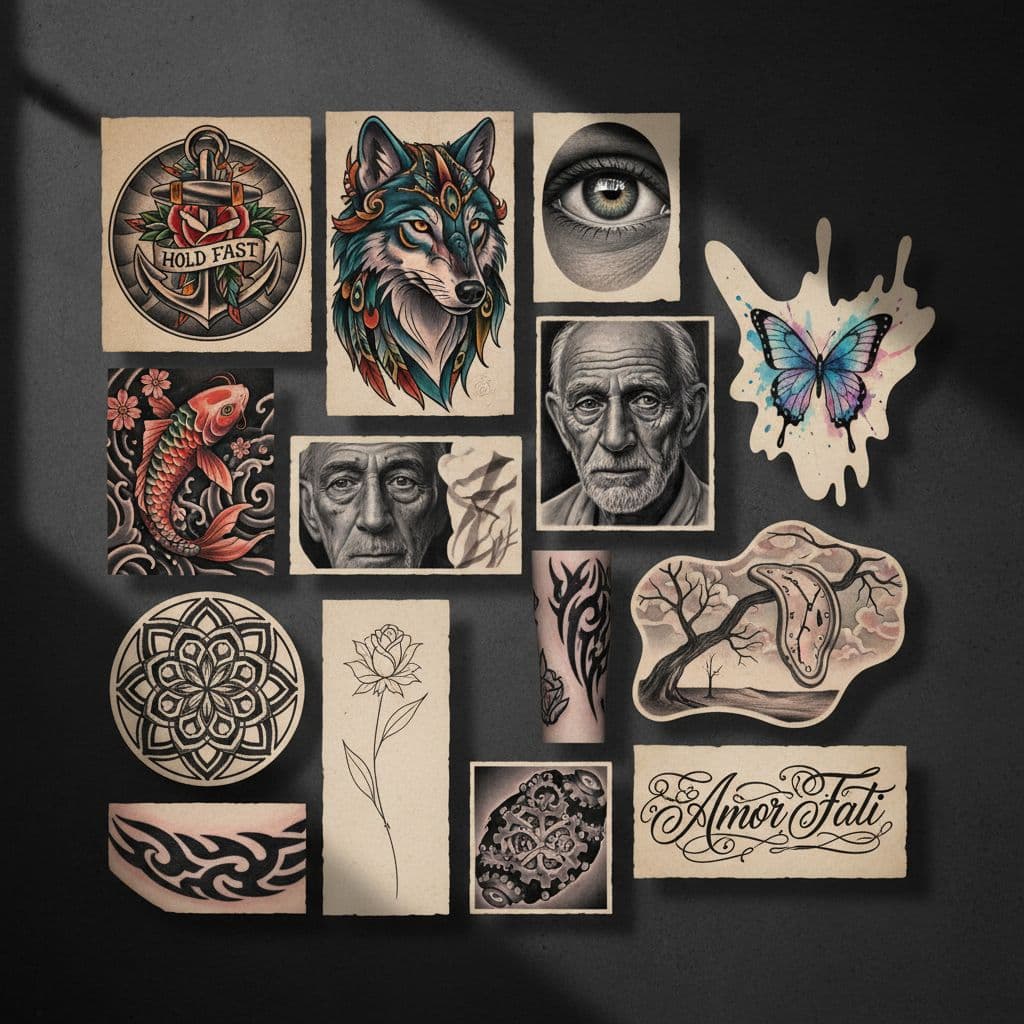
Tattoo styles are the visual rulebooks of tattooing: each one sets the line weight, color palette, shading method, and typical subjects. The main styles are American traditional, neo-traditional, new school, Japanese, realism, black and grey, fine line, blackwork, dotwork, geometric, watercolor, tribal, and lettering. Picking one is also the biggest lever you have when you use an AI tattoo generator, because the style word controls how the whole design looks.
When you type "lion tattoo" into an AI tool, you might get a realistic portrait, a geometric abstraction, a traditional flash design, or something unexpected. This guide explains each major style, gives a master comparison table, and includes one copy-paste prompt per style. I am Francesco, the founder of Ink Studio AI, and I wrote the prompts below after generating a lot of designs in each style.
Tattoo Styles at a Glance
Use this table to compare styles quickly. Origin notes come from the sources linked at the end of the post. The "prompt keywords" column lists words that steer AI tools toward that style. Aging notes are general guidance, since results depend on the artist, the placement, your skin, and sun exposure.
| Style | Era or origin | Key traits | Color | Line weight | Aging notes | Good placements | Prompt keywords |
|---|---|---|---|---|---|---|---|
| American traditional | Early 20th century, sailors and flash walls | 2D, iconic motifs (anchors, roses, daggers) | Limited: red, green, yellow, blue, black | Bold, one weight | Bold lines and solid fills stay readable | Forearm, calf, upper arm | bold outline, flash sheet, limited palette |
| Neo-traditional | Grew out of traditional, popular from the 1980s and 90s | Detailed, Art Nouveau curves, gradients | Wider, muted to jewel tones | Varied (2 to 3 weights) | Holds well when outlines stay bold | Forearm, thigh, shoulder | ornate, jewel tones, art nouveau |
| New school | 1970s | Cartoonish, exaggerated, graffiti influence | Bright, saturated | Bold with 3D effects | Bright fills need touch-ups over time | Arms, legs | cartoon, graffiti, exaggerated |
| Japanese (irezumi) | Edo period, 1603 to 1868 | Folklore subjects, full backgrounds, body-flowing layout | Black, red, green, grey wash | Bold outline | Large planned pieces age as a unit | Back, sleeve, chest | wind bars, waves, irezumi |
| Realism | Modern, photographic | No outline, smooth gradients | Color or black and grey | None or very fine | Fine detail softens first | Thigh, upper arm, calf | photorealistic, soft shading, no outline |
| Black and grey | Long-standing, strongly tied to Chicano work | Grey wash gradients, no color | Black and grey only | Fine to medium | Grey wash heals lighter than fresh | Almost anywhere | black and grey, smooth shading |
| Fine line / minimalist | Social media era | Thin lines, small scale, negative space | Usually black | Very thin | Thin lines can soften and blur | Wrist, ankle, ribs, finger | fine line, single needle, no shading |
| Blackwork | Broad modern category | Heavy black, contrast, patterns | Black only | Medium to solid fills | Solid black holds well | Arm, leg, back | heavy black, negative space |
| Dotwork | Modern, stippling technique | Shading from dot density | Black, sometimes color | Dots, no lines | Dots can merge as ink spreads | Forearm, shoulder, sternum | stippling, dotwork, mandala |
| Geometric | Modern | Symmetry, shapes, patterns | Mostly black | Thin to medium | Fine details need room | Forearm, calf, shoulder | polygonal, symmetrical, sacred geometry |
| Watercolor | 2000s onward | Soft bleeds, splashes, painterly | Vibrant, often pastel | Minimal or none | Soft edges blur without line structure | Ribs, shoulder blade, forearm | color wash, splatter, soft bleeds |
| Tribal and Polynesian | Ancient, many cultures | Bold black patterns, symbolic shapes | Black | Bold | Solid black holds well | Arm, shoulder, calf | bold patterns, solid black, symmetrical |
| Trash polka | Germany | Realism plus abstract collage | Black and red | Mixed | Mixed elements age unevenly | Arm, thigh, back | collage, red splashes, text |
| Chicano | Mexican-American communities, Los Angeles | Black and grey, portraits, script, religious imagery | Black and grey | Fine | Smooth shading needs good contrast | Forearm, chest, back | lowrider, script, rosary, black and grey |
| Sketch and illustrative | Modern | Hatching, visible construction lines | Black, sometimes color | Varied | Light hatching can fade | Forearm, calf, ribs | sketch, cross-hatching, hand-drawn |
| Lettering and script | Ancient to modern | Typography as the design | Usually black | Fine to bold | Small, tight letters can blur | Ribs, forearm, collarbone | script, calligraphy, banner |
| Biomechanical | Modern, sci-fi influence | Machinery under the skin | Black and grey, some color | Medium plus shading | Depends on shading depth | Arm, leg, chest | gears, wires, 3D shading |
| Anime | Modern, pop culture | Manga linework, character art | Color or black | Clean outline | Depends on line and fill | Forearm, thigh, calf | manga, cel shading, clean line |
Most of the facts in the origin column are cited in the sections below. Treat the aging column as practical guidance to confirm with a working artist, not as a guarantee.
Why Tattoo Style Matters More Than Subject
Two tattoos of the same subject, say a rose, can look completely different based on style alone.
- An American Traditional rose has bold black outlines, a limited color palette, and an iconic shape
- A fine-line minimalist rose might be a single continuous line with no shading
- A realistic rose aims to look like a photograph on skin
- A Japanese rose follows specific compositional rules and sits within flowing backgrounds
When you prompt an AI with just "rose tattoo," it has to guess which of these you want. Naming the style removes the guess.
Understanding styles also helps you pick designs for specific placements, talk clearly with tattoo artists, judge how a design will age, and avoid mixing aesthetics that clash.
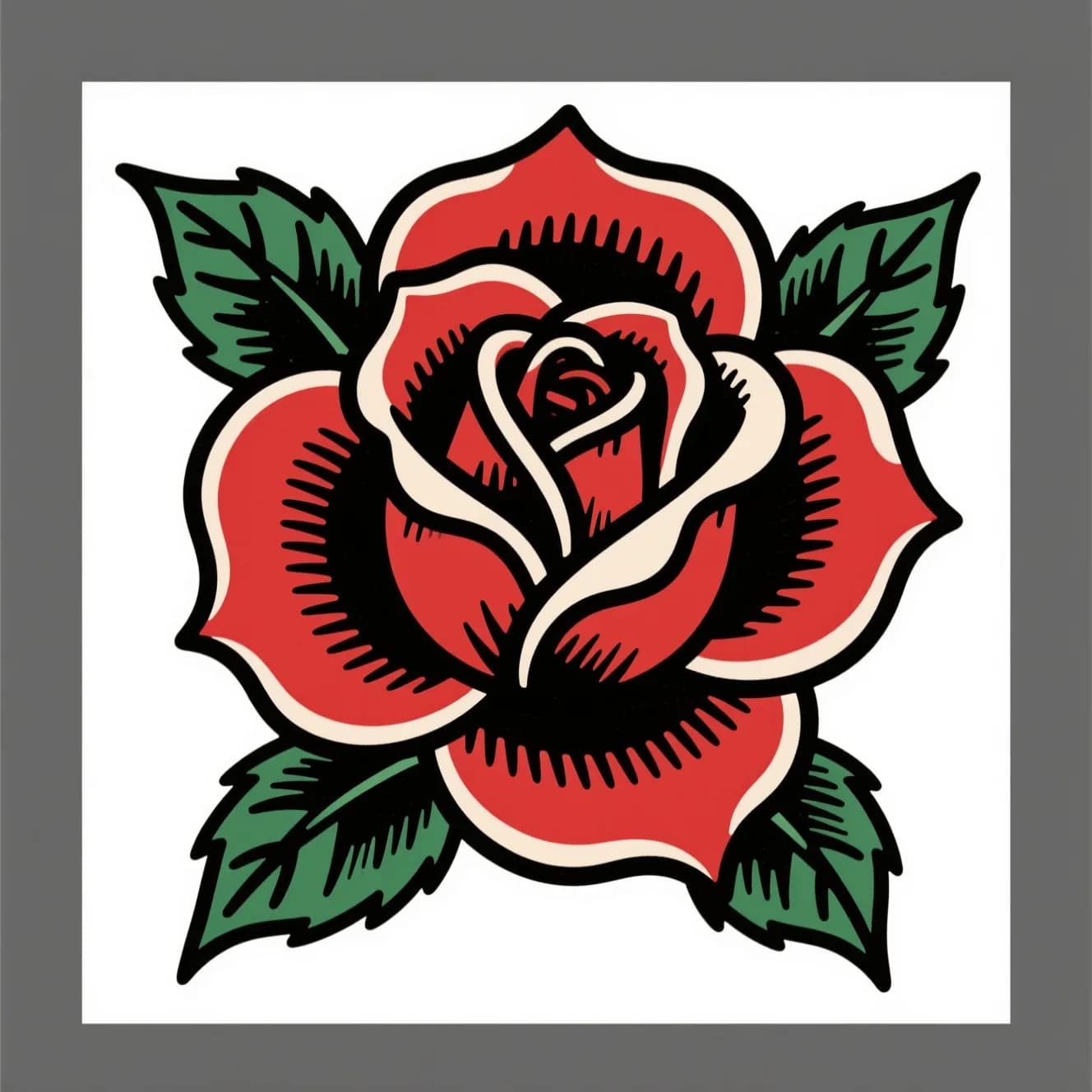 American traditional rose tattoo with bold outlines
1. American Traditional (Old School)
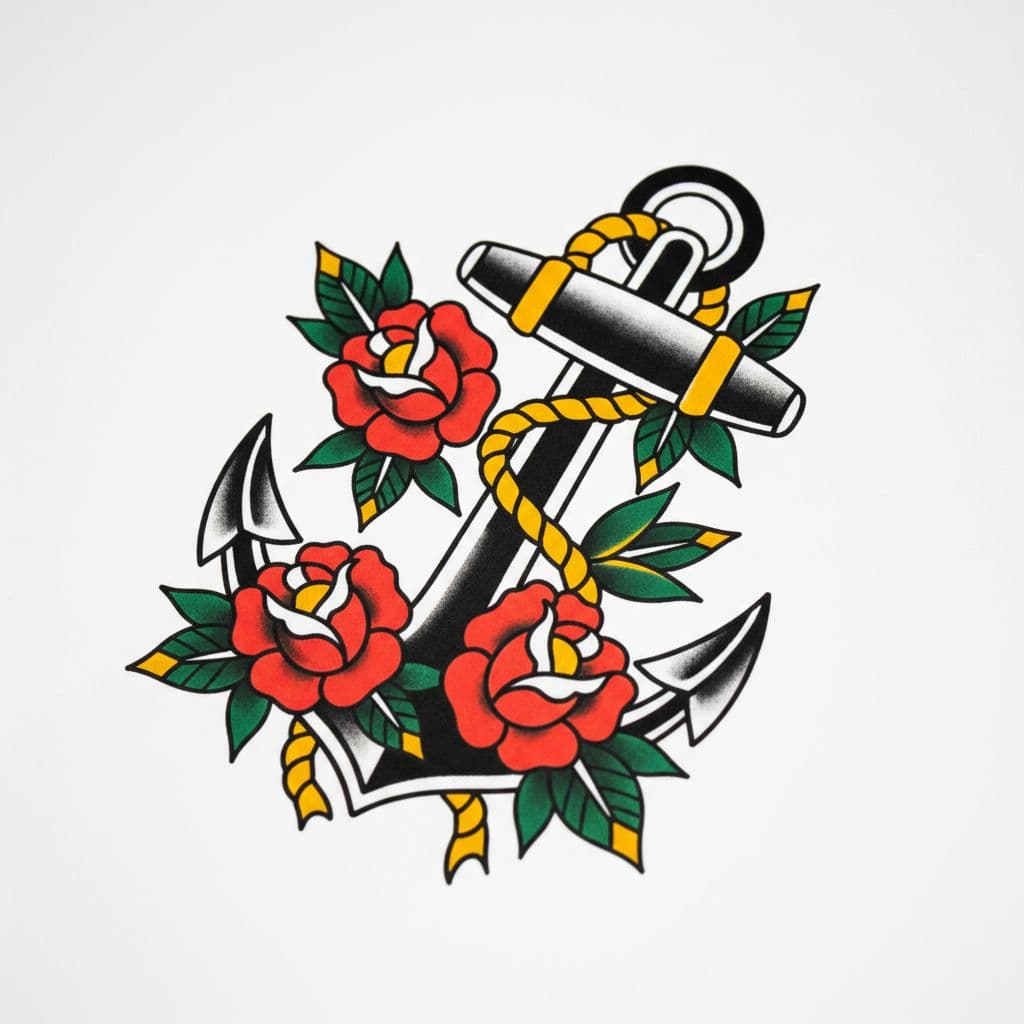 American traditional tattoo with bold outlines and roses
American Traditional tattooing, also called Old School, is the base of modern Western tattooing. It became popular in the early 20th century alongside electric tattoo machines and flash walls, the template drawings that shops displayed for clients to choose from (Tattoos Wizard). Sailors used it to mark achievements at sea. For example, a sparrow was earned for every 5,000 nautical miles traveled, according to the same source.
Explore more in our Traditional style gallery.
- Bold black outlines that never taper or fade
- Limited color palette: red, green, yellow, blue, brown, and black
- Flat, solid color fills with minimal gradients
- Iconic imagery: anchors, swallows, roses, daggers, hearts, eagles, pin-up girls, ships
- 2D, graphic quality rather than realistic depth
Tattooing 101 describes the style as 2D with one line weight (Tattooing 101). That simplicity is also why the bold lines stay legible as skin changes.
How AI Handles Traditional
AI generators do well here because the style has clear, consistent rules and there is a lot of traditional flash art online. Bold lines and flat colors are easy to reproduce.
Copy-paste prompt:
American traditional eagle tattoo, bold black outlines, limited color palette of red, green, yellow, and blue, flat solid fills, vintage flash sheet style
Two more variations: "Sailor Jerry style rose and dagger, bold lines, solid color fills, old school tattoo" and "Traditional swallow tattoo, red and blue, bold outline."
Pro tip: Add "flash sheet style" or "Sailor Jerry inspired" for the most authentic results.
Substyles to Know
- Western Traditional: Cowboy imagery such as horseshoes, skulls, cacti, revolvers
- Maritime Traditional: Ships, anchors, mermaids, nautical stars
- Military Traditional: Eagles, flags, weapons, memorial designs
2. Neo-Traditional
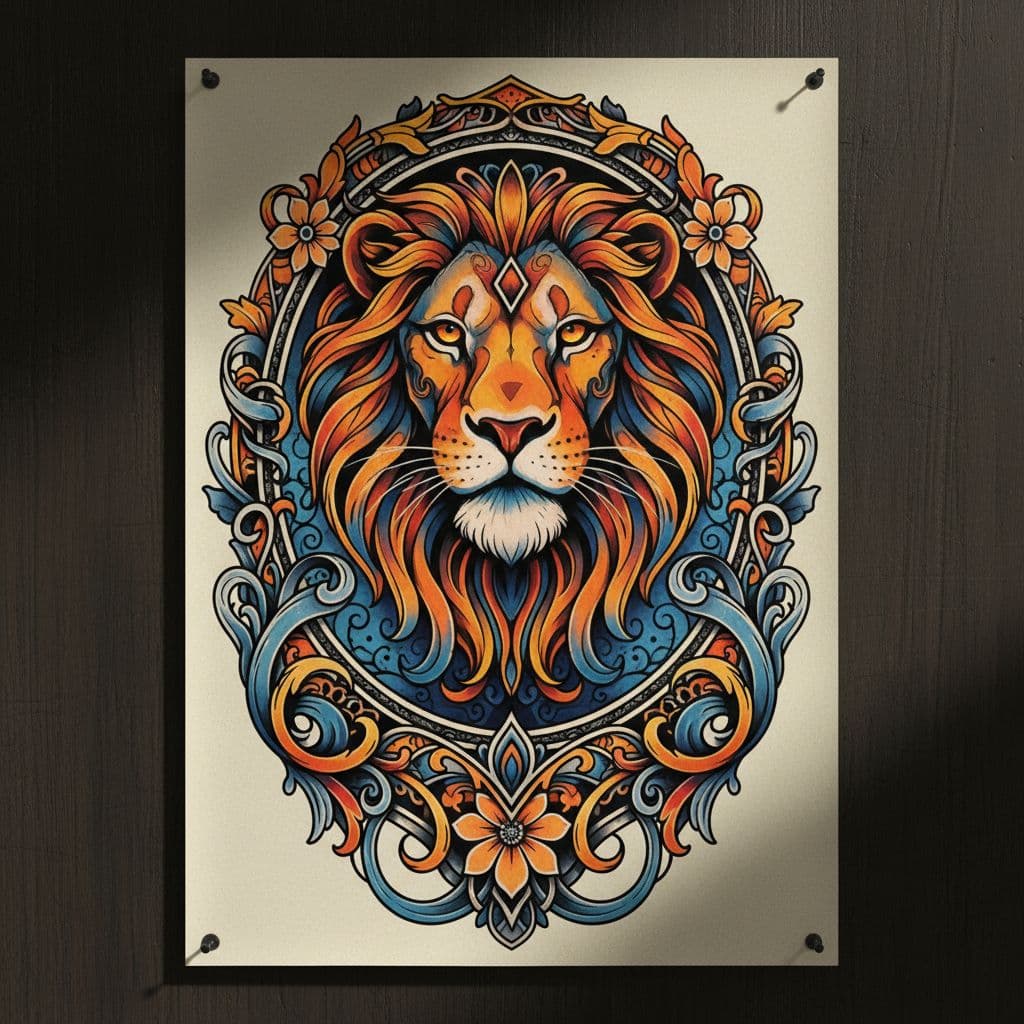 Neo-traditional tattoo with vibrant colors
Neo-Traditional evolved from American Traditional. It developed as a style of its own and grew popular in the 1980s and 90s (Tattoos Wizard). It keeps dark outlines but uses a wider color range, more detail, and smoother gradients.
See examples in our Neo-Traditional style gallery.
- Bold outlines that can vary in weight (Tattooing 101 suggests 2 to 3 line weights)
- Expanded color palettes including purples, pinks, teals, and subtle gradients
- More detailed and illustrative than traditional
- Art Nouveau curves and Art Deco detail such as filigree
- Subjects range wider: ornate animals, flowers, birds, stylized portraits
Neo-Traditional artists often add decorative elements like filigree, gems, and elaborate backgrounds.
How AI Handles Neo-Traditional
This is where AI does well. Clear linework combined with room for decoration plays to its strengths.
Copy-paste prompt:
Neo-traditional wolf portrait tattoo, ornate details, bold outlines with smooth color gradients, jewel tones of emerald, ruby, and gold, decorative frame elements
Pro tip: Name specific colors. Neo-traditional loves jewel tones, such as "deep purple and teal gradient."
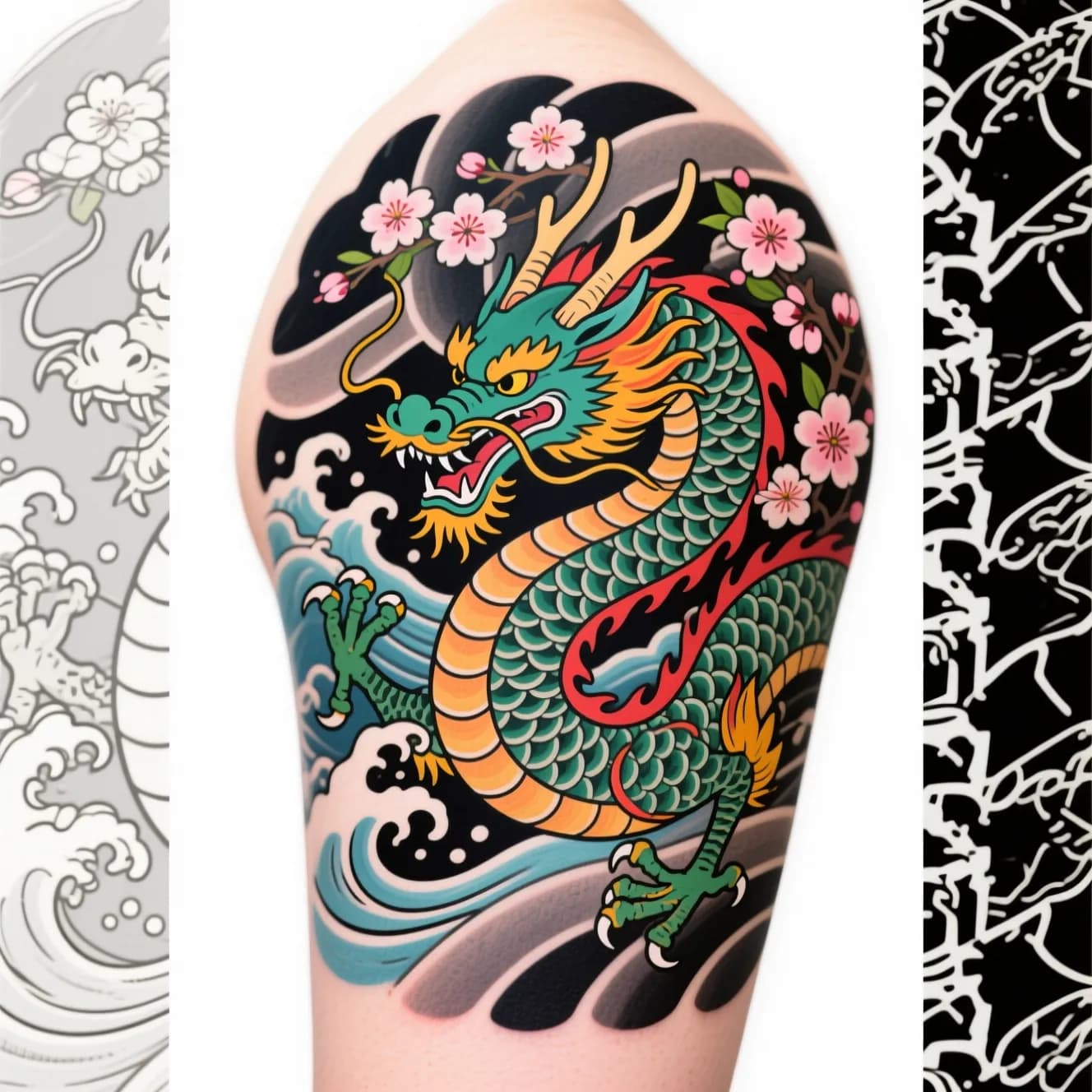 Japanese dragon tattoo with waves and cherry blossoms
3. New School
New School is the rebellious cousin of Old School. Tattoos Wizard dates it to the 1970s and describes it as inspired by graffiti, cartoons, hip hop, and pop art, with vibrant colors and intentional disproportion (Tattoos Wizard). Tattooing 101 notes that faces often get oversized features, like big eyes or big teeth (Tattooing 101).
Copy-paste prompt:
New school tattoo of a grinning cartoon octopus, exaggerated proportions, bright saturated colors, graffiti-style 3D shading, thick outlines
Pro tip: Say "cartoon" and "exaggerated proportions" explicitly. Without them, AI tends to drift toward neo-traditional.
4. Japanese (Irezumi)
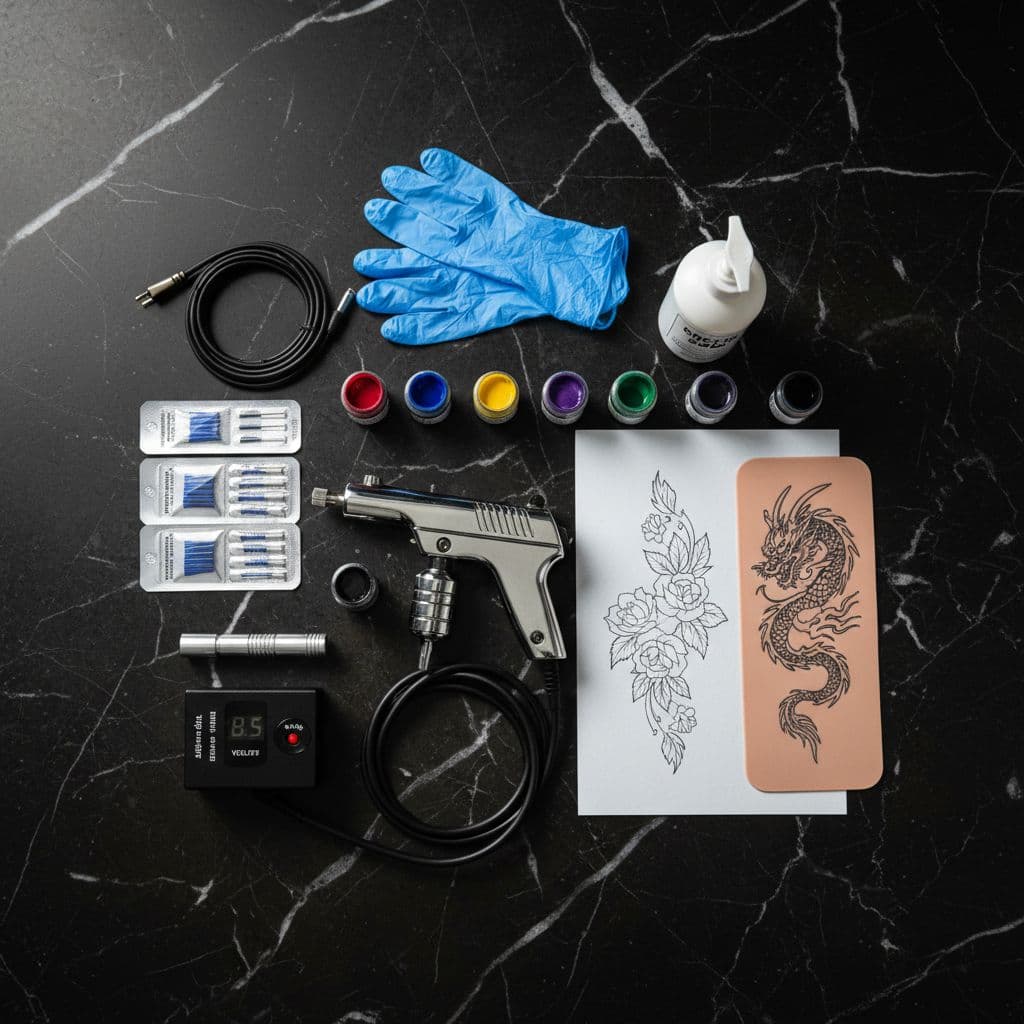 Japanese tattoo with traditional elements
Japanese tattooing (Irezumi) is one of the oldest and most codified tattoo traditions. Tattoodo traces the traditional style to the Edo period (1603 to 1868), alongside ukiyo-e woodblock prints, with subjects drawn from folklore such as dragons, kirin, and phoenixes (Tattoodo).
Browse our Japanese style gallery for inspiration.
- Subject matter follows tradition: koi fish, dragons, phoenixes, tigers, snakes, peonies, chrysanthemums, cherry blossoms, waves
- Backgrounds are essential: clouds, water, wind, and rocks fill negative space
- Composition flows with the body rather than sitting as an isolated image
- Color follows conventions: specific reds, blacks, and greens, with lots of black and grey shading
- Symbolic meaning matters: each element carries cultural significance
Japanese sleeves and back pieces are designed to work together as one composition.
How AI Handles Japanese
AI can produce striking Japanese-style imagery, but you need to be specific. Without guidance it may mix elements inappropriately or skip the background work that defines the style.
Copy-paste prompt:
Traditional Japanese irezumi koi fish swimming upstream, wave background, wind bars, bold black outline with red and orange accents, flowing composition
Pro tip: Always mention the background: "wave background," "clouds and wind bars," or "cherry blossom scatter."
Key Subjects and Their Meanings
| Subject | Meaning |
|---|---|
| Koi fish | Perseverance, determination, good fortune |
| Dragon | Wisdom, strength, protection |
| Tiger | Courage, strength, protection against evil |
| Phoenix | Rebirth, triumph, immortality |
| Snake | Protection, wisdom, good luck |
| Peony | Wealth, prosperity, beauty |
| Cherry blossom | Life's fleeting nature, beauty |
| Hannya mask | Complex emotions, jealousy transformed |
Note that anime tattoos are a separate category with little connection to Japanese irezumi, a distinction Tattoos Wizard also makes.
5. Realism and Photorealism
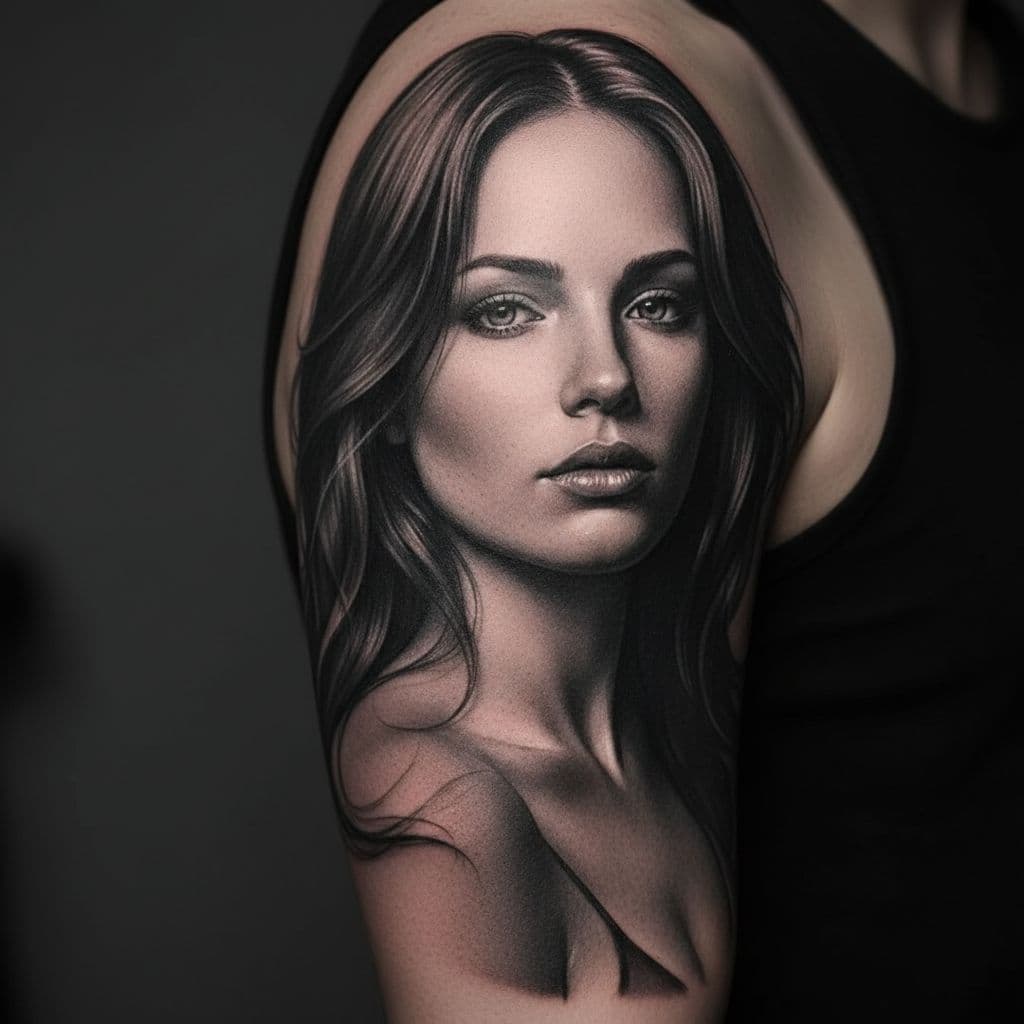 Realistic black and grey tattoo
Realistic tattoos aim to look like photographs or hyperrealistic paintings on skin. Tattooing 101 notes that realism is in higher demand than other styles and is the most expensive style to get tattooed (Tattooing 101). For budget planning, see our guide on how much a tattoo costs.
View our Realism style gallery for examples.
- No outlines or minimal outlines, with shapes defined by shading
- Extensive gradients and smooth transitions
- High detail and texture: fur, fabric, reflections
- Black and grey realism uses black ink in various dilutions
- Color realism adds lifelike hues
Common subjects include portraits (people, pets), nature scenes, objects, and surrealist compositions.
How AI Handles Realism
AI image generators are good at photorealistic imagery, but turning that into a tattoo design needs specific prompting. You want something realistic that is still clearly designed for skin.
Copy-paste prompt:
Realistic black and grey lion portrait tattoo design, detailed fur texture, soft shading, smooth transitions, no outline, dramatic lighting
Pro tip: Say "tattoo design" even for realism. Otherwise AI may generate a photograph.
The Black and Grey vs Color Decision
Black and grey realism: often chosen for a timeless look and tends to be more forgiving of skin tone variation. Tattooing 101 notes that grey wash heals about 30% lighter than when fresh, which artists account for while tattooing.
Color realism: more striking at first, but color placement matters more for how it reads as the tattoo settles. Ask your artist about your skin tone and the palette.
For AI generation, be explicit: "black and grey realism" or "full color realistic" changes results a lot. If portraits are your goal, read our guide to the best portrait tattoo styles.
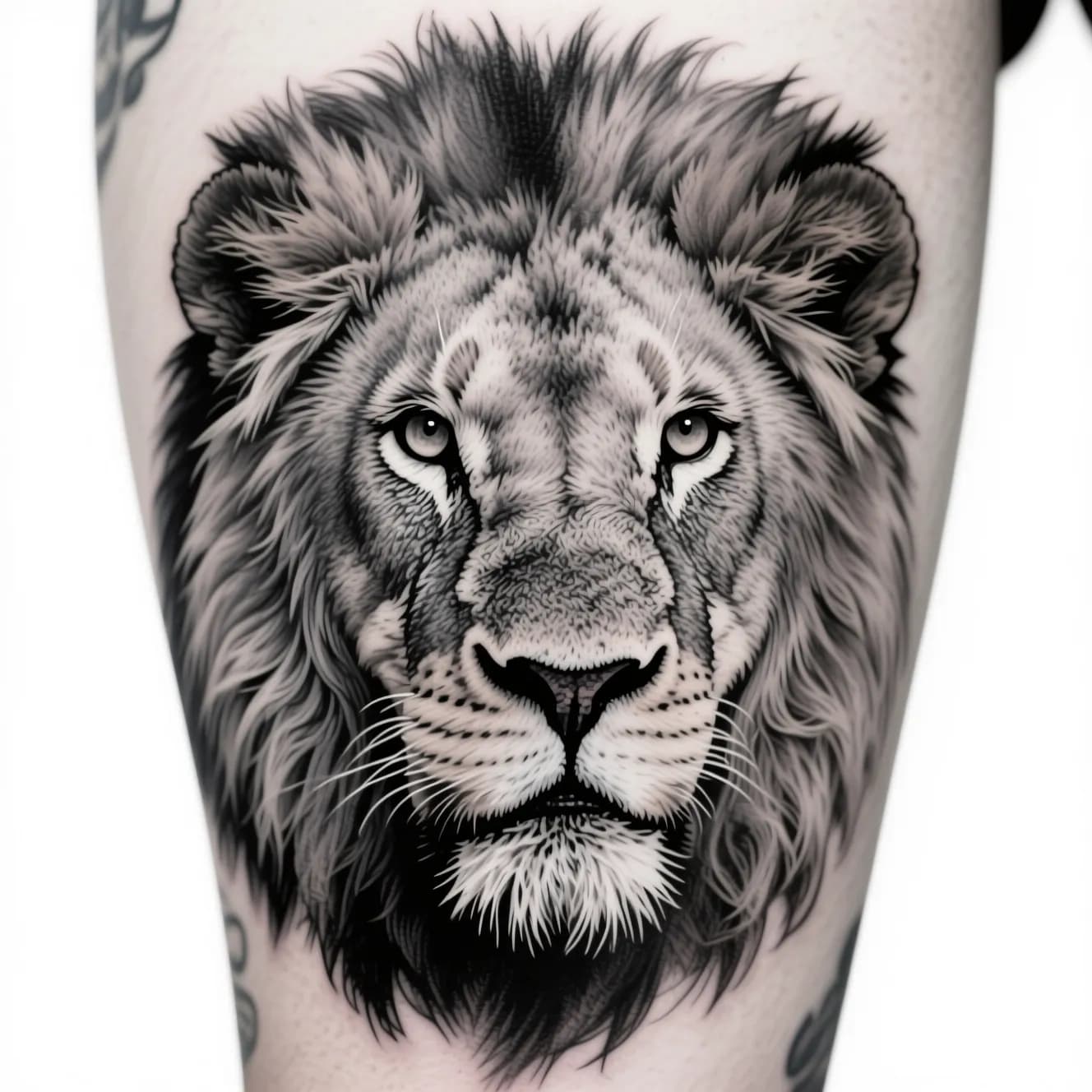 Realistic black and grey lion portrait tattoo
6. Black and Grey
Black and grey is defined by one rule: no color, with every tonal change made from grey wash gradients (Tattooing 101). It covers almost any subject, including roses, pocket watches, people, skulls, and animals. Tattooing 101 also separates it from blackwork: blackwork uses only black ink and brush-style shading, while black and grey uses grey wash for smoother shades.
Copy-paste prompt:
Black and grey tattoo design of a pocket watch and roses, smooth grey wash shading, no color, soft gradients, high detail
Pro tip: If you want realism without a photographic look, say "black and grey" rather than "realistic," and AI will give you shading-led designs with more graphic structure.
7. Fine Line and Minimalist
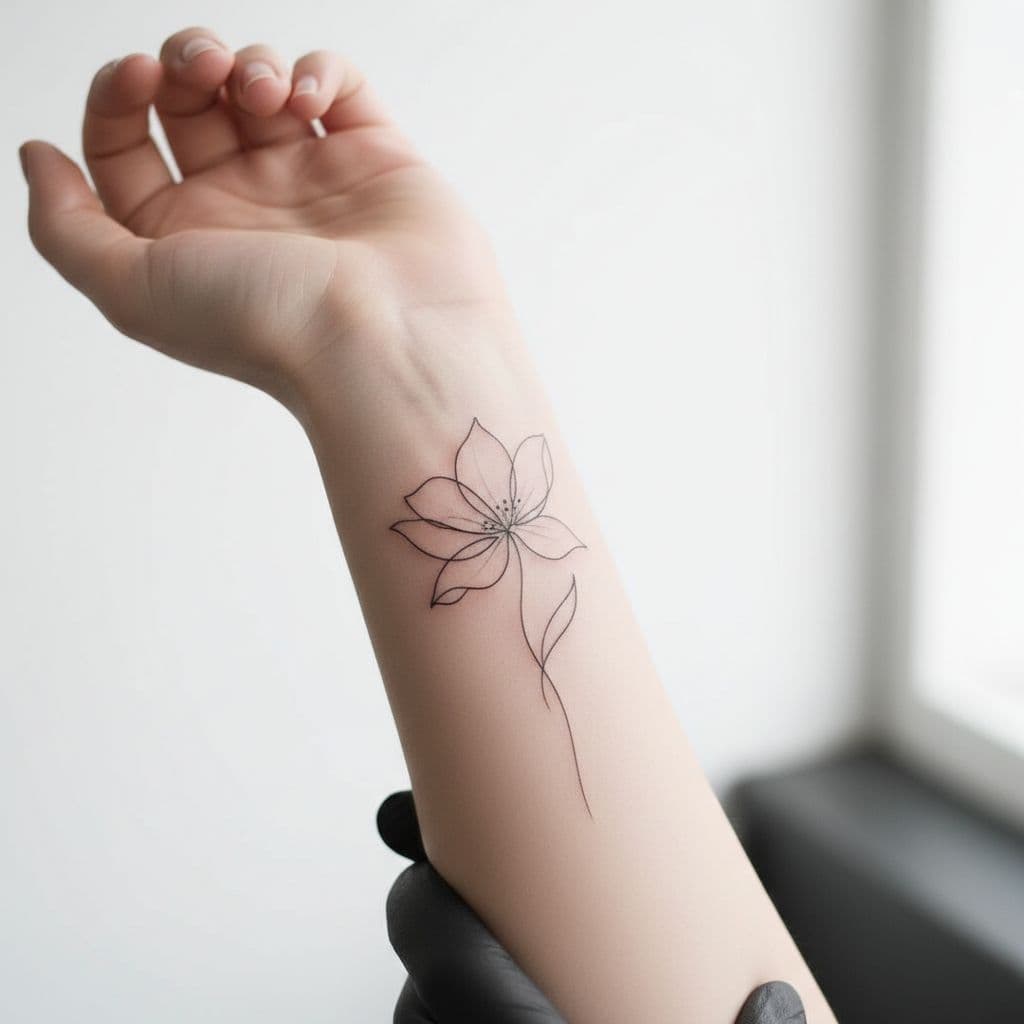 Minimalist fine line tattoo
Fine line work is the opposite of bold traditional styles. It became popular through Instagram and is common for small, discreet tattoos.
Explore delicate designs in our Minimalist style gallery.
- Single-needle or thin line work
- Delicate, thin lines that create airy designs
- Minimal shading or none
- Often small scale and suited to delicate placements
- Clean negative space as part of the design
- Continuous line designs where one unbroken line draws the whole image
A caution from Tattooing 101 about small, tight details: ink spreads a little over time, so lettering and fine details that sit too close together can turn into a blur (Tattooing 101). The same applies to very small fine line pieces.
How AI Handles Fine Line
Fine line suits AI because simplicity leaves fewer places for errors.
Copy-paste prompt:
Minimalist fine line botanical leaves tattoo, single needle style, delicate linework, no shading, small design for the wrist, white background
More variations: "Single line continuous cat drawing, minimal, no shading" and "Continuous line face portrait, one line drawing."
Pro tip: Add "no shading" or "linework only." Mentioning placement ("small design for finger") helps AI scale the complexity.
Related Styles
- Micro tattoos: Extremely small, detailed fine line work. Monolith Studio lists micro realism and single line tattoos as their own categories (Monolith Studio)
- Dainty tattoos: Small, delicate designs
- Single needle: Technically a method, but often used as a style descriptor
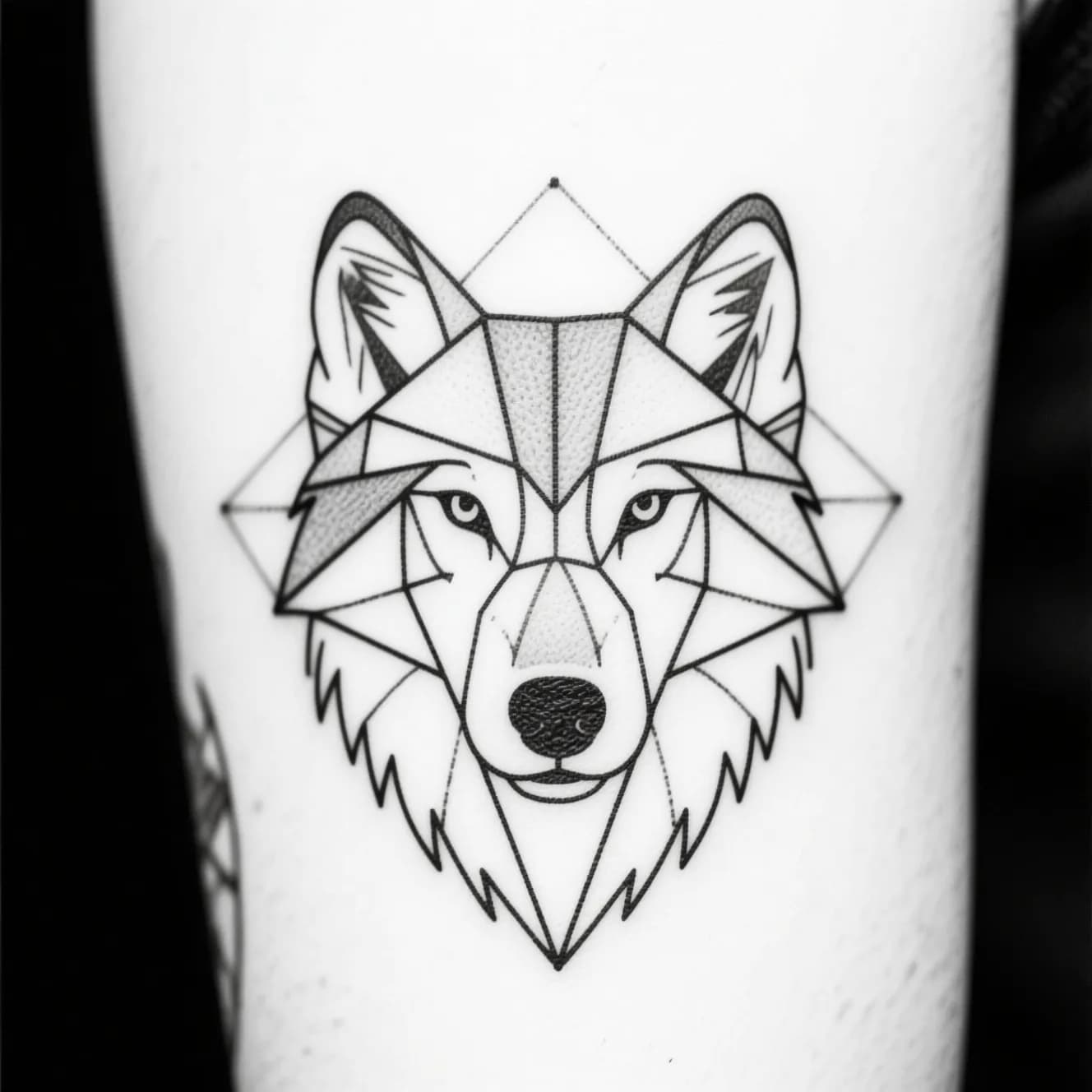 Minimalist fine line geometric wolf tattoo
8. Geometric and Sacred Geometry
Geometric tattoos use mathematical shapes and patterns as their foundation. Precision of this kind is something AI handles well.
Discover patterns in our Geometric style gallery.
- Precise lines and shapes: circles, triangles, hexagons, mandalas
- Perfect symmetry (or intentional asymmetry)
- Pattern repetition and tessellation
- Often black ink only, though color can work
- Sacred geometry uses spiritually significant patterns: flower of life, Metatron's cube, golden ratio spirals
- Can be abstract or combine geometry with other imagery, like geometric animals
How AI Handles Geometric
Symmetry and clean lines are easy for AI, so results are often cleaner than hand-drawn concepts. Remember that the tattoo artist still has to execute the lines by hand.
Copy-paste prompt:
Geometric wolf head tattoo, polygonal low-poly style, sharp angles, black linework only, perfectly symmetrical
Pro tip: Ask for "mathematically precise" or "perfect symmetry."
Key Geometric Elements
- Mandalas: Circular, symmetrical spiritual diagrams
- Flower of Life: Overlapping circles creating a flower pattern
- Metatron's Cube: Complex geometric figure built from circles and lines
- Platonic solids: Tetrahedron, cube, octahedron, dodecahedron, icosahedron
- Golden ratio and Fibonacci: Spiral patterns found in nature
9. Blackwork
Blackwork is a broad category: Tattoodo describes it as almost any body art done solely in black ink, running from ancient sacred geometry to modern abstract ornamental designs and detailed illustrative pieces (Tattoodo).
- Heavy black saturation and solid fills
- High contrast between ink and skin
- Simple to extremely intricate
- Often includes patterns: geometric, ornamental, tribal influences
- Negative space (untattooed skin) becomes a design element
- Includes blast-over and cover-ups using heavy black
How AI Handles Blackwork
High contrast and clear parameters make blackwork easy for AI to understand. Specify the substyle for best results.
Copy-paste prompt:
Ornamental blackwork sleeve design, heavy black fills, intricate baroque patterns, negative space, high contrast
Blackwork Substyles
Ornamental blackwork: intricate, decorative patterns inspired by henna, lace, and architectural detail. Often frames other tattoos or builds sleeves.
Tribal blackwork: bold, solid shapes, drawing on Polynesian, Maori, and Borneo traditions. Modern versions are often more abstract.
Blackout: large areas of solid black ink, creating dramatic negative-space designs. Popular for cover-ups.
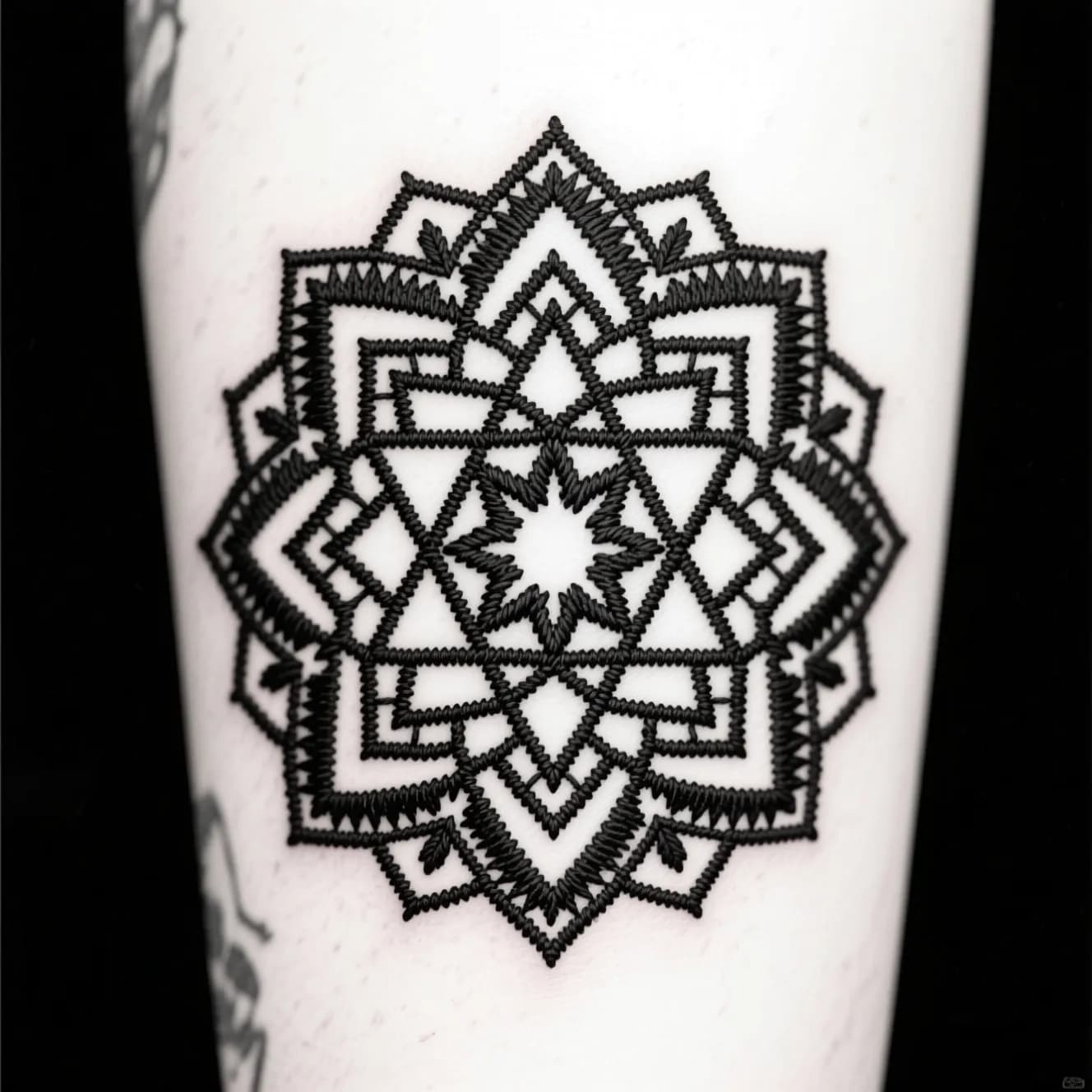 Blackwork ornamental mandala tattoo pattern
10. Dotwork
Dotwork builds images from thousands of dots instead of lines or solid fills. Monolith Studio notes it demands precision and patience from the artist (Monolith Studio).
- Stippling technique, where dot density creates shading
- Often intricate, with mandala or geometric subjects
- Frequently combined with geometric and sacred geometry
- Black ink most common, but color is possible
How AI Handles Dotwork
AI makes consistent stippling patterns that would take hours to plan by hand. It is one of the more reliable styles to generate.
Copy-paste prompt:
Dotwork mandala tattoo, intricate stippling, sacred geometry, perfectly symmetrical, black ink on white background
Pro tip: Combine dotwork with geometric elements: "geometric dotwork" or "sacred geometry with stipple shading."
11. Watercolor
Watercolor tattoos mimic watercolor paintings, with soft, flowing color that appears to bleed beyond lines. Tattooing 101 describes soft-looking edges and plenty of color, often pastels, and recommends including some line work so the design stays readable as the ink fades and spreads (Tattooing 101).
View our Watercolor style gallery for inspiration.
- Soft, flowing color with bleeds past the lines
- Splashes, drips, and washes
- Often combined with fine line outlines or silhouettes
- Minimal or no black outlines in pure watercolor
- Organic, fluid shapes rather than rigid boundaries
How AI Handles Watercolor
AI captures soft bleeds and color transitions well. The challenge is keeping the design readable as a tattoo rather than a painting.
Copy-paste prompt:
Watercolor hummingbird tattoo design, vibrant color splashes, soft bleeds, fine line outline for structure, white background
Pro tip: Add "tattoo design" and "with fine line outline." Pure watercolor can look abstract without some structure.
12. Tribal and Polynesian
Tribal covers several indigenous traditions. Tattoos Wizard lists Maori, Aboriginal Dreamtime, Hawaiian kakau, and Samoan designs among them, and notes that the 1990s-style bicep bands are better described as "new tribal" because they do not come from one indigenous tradition (Tattoos Wizard).
Tribal designs use bold black shapes, repetition, and symbols tied to community, status, and ritual. If you want a Polynesian or Maori design, work with an artist from or trained in that culture. These patterns carry meaning, and an AI concept can only show you the general look.
Copy-paste prompt:
Polynesian-inspired bold black armband tattoo, repeating symmetrical patterns, solid black shapes, flowing around the arm
13. Trash Polka
Trash Polka originated in Germany and mixes photorealistic elements with abstract shapes, text, and splashes of red and black (Monolith Studio). It looks like a collage and polarizes people.
- Black and red ink only, traditionally
- Chaotic collage aesthetic
- Text, smudges, and graphic elements
- Asymmetrical composition
How AI Handles Trash Polka
It is hard for AI because "controlled chaos" is difficult to describe. List the exact elements you want combined.
Copy-paste prompt:
Trash polka skull design, black and red only, realistic skull combined with abstract geometric shapes, red paint splashes, smudge effects, small text elements
14. Chicano
Tattoodo describes Chicano style as shaped by Mexican Revolution history, Los Angeles low-rider culture, and Pachuco culture, with roots in prison tattooing, and usually fine line, black and grey (Tattoodo). Typical imagery includes religious iconography, La Catrina, lowriders, roses, portraits, and script lettering.
Copy-paste prompt:
Chicano style Virgin Mary portrait tattoo, black and grey, smooth shading, roses and rosary, fine line details, script banner
Pro tip: Name "Chicano style" explicitly. Otherwise you get generic black and grey work without the cultural specifics.
15. Sketch and Illustrative
Illustrative covers many techniques. Tattoodo says it draws on etching, engraving, abstract expressionism, and fine line calligraphy, and that the work should look like it could hang in a gallery as a drawing or painting (Tattoodo). Sketch styles go further and keep visible construction lines and hatching.
- Visible sketch lines and cross-hatching
- Deliberately imperfect, organic edges
- Looks like pen or pencil transferred to skin
Copy-paste prompt:
Sketch style anatomical heart tattoo, visible pen strokes, cross-hatching shading, hand-drawn look, construction lines visible, unfinished edges
Pro tip: Words like "hand-drawn" and "unfinished quality" override AI's habit of producing polished images.
16. Lettering and Script
Lettering uses typography as the design. Tattooing 101 gives practical rules that also apply to your AI concepts: leave enough space between letters, have someone else read the text, and verify spelling and translations (Tattooing 101). It also notes that name tattoos are often covered up later.
Copy-paste prompt:
Elegant cursive script tattoo reading "Mi Familia", fine line black ink, flowing calligraphy, small decorative flourish, plenty of letter spacing
Our tattoo font generator is useful for testing lettering before you commit. AI image tools can misspell words, so always check the text yourself.
17. Biomechanical, Ornamental, Surrealism, and Anime
Four more styles show up often in artist portfolios:
- Biomechanical: machinery under the skin, with gears, wires, and 3D shading (Monolith Studio). Prompt:
Biomechanical forearm tattoo, exposed gears and wires beneath torn skin, black and grey, deep 3D shading - Ornamental: decorative patterns inspired by jewelry, lace, and architecture, often used to accent wrists, neck, or back (Monolith Studio). Prompt:
Ornamental lace chest piece tattoo, symmetrical filigree, fine black linework, jewelry-inspired details - Surrealism: dreamlike mixes of unrelated elements, like a clock melting over a tree (Biomaser). Prompt:
Surrealist tattoo of a melting clock over a tree, dreamlike composition, black and grey, soft shading - Anime: manga-inspired character art, separate from Japanese irezumi. Prompt:
Anime character tattoo design, manga linework, clean outline, cel shading, dynamic pose
Which Styles Does AI Handle Best?
Based on my own testing across multiple AI tattoo generators, including Ink Studio AI, here is how styles rank for generation quality. This is an informal ranking from my experience, not a benchmark.
Reliable results:
- Geometric: precision is AI's strength
- Dotwork: consistent stippling patterns
- Fine line and minimalist: simplicity means fewer errors
- American traditional: clear rules and a lot of reference art
- Neo-traditional: structured but creative
- Blackwork: high contrast, clear parameters
Good results with specific prompting: 7. Japanese: needs background elements named 8. Realism: must say "tattoo design" 9. Watercolor: needs structural elements
Challenging, but possible with detailed prompts: 10. Trash polka: controlled chaos is hard to describe 11. Sketch and illustrative: AI defaults to finished looks 12. Chicano: cultural specifics must be spelled out
How to Pick a Tattoo Style
If you are unsure, work through these five questions in order.
- What is the subject? Portraits and pets lean toward realism or black and grey. Symbols and animals suit traditional and neo-traditional. Words suit lettering or fine line.
- How big will it be? Small pieces suit fine line, minimalist, and simple geometric. Sleeves and back pieces suit Japanese, blackwork, and large realism.
- Where will it go? Curved or high-movement areas like ribs and fingers favor simple designs. See our tattoo placement guide for how placement affects detail.
- How should it look in ten years? Bold outlines and solid fills give you the most margin. Very fine detail and soft edges are less forgiving.
- Do you want bold or quiet? Traditional and Japanese read from across the room. Fine line and dotwork read up close.
You can generate a concept in three or four styles in minutes and compare. Our style transfer tool can restyle one image into different looks, which makes the comparison easy.
How Tattoo Styles Age
No style is immune to aging, and results depend heavily on the artist, placement, and sun exposure. These points come from the sources I read and from general tattoo practice.
- Bold outlines and solid fills are the most forgiving. Monolith Studio describes American Traditional as durable and timeless (Monolith Studio).
- Ink spreads a little over time. Tattooing 101 warns that tightly packed letters or details can turn into a blur (Tattooing 101). Very small fine line work and dense dotwork follow the same logic.
- Grey wash heals lighter. Tattooing 101 notes it heals about 30% lighter than when fresh.
- Soft color edges need structure. Watercolor designs benefit from some line work so they stay readable as the ink fades and spreads.
Before you finalize any design, ask your artist how they expect it to settle.
How to Read an Artist's Style From Their Portfolio
Style names are fuzzy, so the portfolio matters more than the label. Tattoodo makes the same point about illustrative work: many artists blend their own aesthetic into a style until it becomes something new.
- Look at healed photos, not only fresh ones. Fresh tattoos always look sharp.
- Check line consistency. Are the lines steady in the same weight across the piece?
- Look for repeated motifs and palettes. An artist who posts only black and grey portraits is a realism specialist, whatever their bio says.
- Match the portfolio to your idea. If you want neo-traditional, find an artist whose work is mostly neo-traditional.
- Ask about your specific design. Bring your AI concept as a reference, not as a final stencil.
Bring your AI concept as a reference, not a final stencil.
How to Combine Styles Successfully
Some combinations work, and some clash.
Combinations that tend to work:
- Geometric and dotwork
- Fine line and watercolor
- Neo-traditional with Japanese influences
- Realism with geometric frames or backgrounds
- Blackwork with geometric patterns
Combinations to avoid:
- American Traditional and realism (conflicting line philosophies)
- Watercolor and heavy blackwork (aesthetic clash)
- Several "main" styles at once, such as Japanese, Chicano, and Trash Polka
Prompts for style combinations:
Geometric wolf with dotwork shading, sacred geometry background, black ink onlyRealistic rose with geometric frame, fine line accents, black and greyFine line hummingbird with watercolor splash background, minimal outline
Style Selection by Body Placement
Different styles suit different body areas.
| Body Area | Best Styles | Why |
|---|---|---|
| Forearm | Traditional, Neo-trad, Japanese, Geometric | Good canvas size, visible |
| Upper arm/Shoulder | Realism, Japanese, Blackwork | Larger canvas for detail |
| Ribs/Side | Fine line, Script, Watercolor | Follows body contours |
| Back | Japanese, Large blackwork, Realism | Maximum canvas |
| Fingers/Hands | Fine line, Simple geometric, Script | Small scale works best |
| Wrist | Minimalist, Fine line, Small traditional | Delicate area |
| Ankle | Fine line, Small geometric, Dainty | Limited space |
When prompting AI, mentioning placement calibrates complexity: "small wrist tattoo" yields simpler designs than "full sleeve design."
Quick Reference: Style Prompt Cheat Sheet
Copy these structures and replace the bracketed parts:
American Traditional:
"American traditional [SUBJECT], bold black outlines, limited color palette (red, green, yellow, blue), flat solid fills, vintage flash style"
Neo-Traditional:
"Neo-traditional [SUBJECT], bold outlines with color gradients, ornate details, [jewel tone colors], illustrative style"
Japanese:
"Traditional Japanese irezumi [SUBJECT], [wave/cloud/wind bar] background, bold black outline, [colors], flowing composition"
Realism:
"[Black and grey/Color] realistic [SUBJECT] tattoo design, detailed shading, smooth transitions, photorealistic quality"
Fine Line:
"Fine line [SUBJECT], single needle style, minimal/no shading, delicate linework, small design"
Geometric:
"Geometric [SUBJECT], [polygonal/sacred geometry/mandala] style, precise lines, [symmetrical/black ink only]"
Blackwork:
"Blackwork [SUBJECT], heavy black saturation, high contrast, [ornamental/tribal/solid] style"
Dotwork:
"Dotwork [SUBJECT], stipple shading, intricate details, [geometric elements], black ink"
Watercolor:
"Watercolor [SUBJECT] tattoo, color splashes, soft bleeds, [with fine line outline], artistic paint effect"
Start Designing
Understanding tattoo styles turns AI generation from random to intentional. Name the style, the line weight, the palette, and the placement, and the output improves. Treat the result as a concept to discuss with an artist, since a tattoo artist adapts any design to your skin and placement.
Try our AI tattoo generator with the prompts above. For more help writing prompts, read our complete AI tattoo prompt writing guide. You can also browse every style in our tattoo styles gallery.
Frequently Asked Questions
What are the main tattoo styles?
The most common are American traditional, neo-traditional, new school, Japanese, realism, black and grey, fine line, blackwork, dotwork, geometric, watercolor, tribal, and lettering. Tattooing 101 and Tattoodo both cover traditional, neo-traditional, new school, Japanese, realism, blackwork, tribal, and watercolor as core styles. Smaller niches like trash polka, biomechanical, and cybersigilism sit on top of those.
What tattoo style is best for a first tattoo?
A simple, well-defined style is a safe pick: American traditional, fine line, or a small geometric design. Traditional has clear rules and bold lines, and fine line works well at small sizes. Pick an artist who specializes in your chosen style, and start with a size you can live with.
What tattoo style ages best?
Bold outlines and solid fills give the most margin, which is why American traditional and blackwork are common answers. Ink spreads over time, so tight details and very small fine line work are less forgiving. Ask your artist to show healed work in your chosen style.
What is the most popular tattoo style?
I could not find a reliable 2026 ranking, so I will not name one. Tattooing 101 calls black and grey one of the most popular styles, and Tattoodo, Monolith Studio, and Tattoos Wizard all lead with traditional and realism. Popularity varies by region and by artist.
Can you mix tattoo styles?
Yes, if you choose one main style and one supporting element. Geometric with dotwork, fine line with watercolor, and neo-traditional with Japanese influences work well. Avoid combining styles with opposing line philosophies, such as traditional bold outlines and outline-free realism.
Which tattoo styles work best with AI generators?
Geometric, dotwork, fine line, traditional, and blackwork are the most reliable, based on my testing. Realism and watercolor need more careful prompts. In every case, treat the output as a concept, not a finished stencil.
What is the difference between a style in an AI prompt and a style in tattooing?
In a prompt, the style guides the look: lines, colors, shading. In tattooing, style also involves technique, such as needle configuration and ink dilution. AI gives you a visual idea, and a skilled artist brings the technique. Take any AI concept to a professional.
How do I know which style matches my idea?
Start with the subject and the feeling. Bold and timeless suggests traditional, delicate and modern suggests fine line, and a large flowing story suggests Japanese. Generate the same subject in two or three styles and see which one feels right.