 Francesco Chiaramonte
Tattoo peeling is normal. Most new tattoos start to flake around day 3 to 5, peel hardest in days 7 to 10, and finish the visible peel by the end of week two. The flakes are dead surface skin, and the ink stays in the deeper layer. Thin, flat scabs over heavy shading are also normal. Spreading redness, heat, pus, worsening pain, or fever are not normal, and they need a doctor.
That is the short answer. The rest of this guide is for the moment on day five when you look down at your new piece and see flaky skin, cloudy patches, and maybe a few crusty scabs, and your first thought is: "Did I ruin it?"
Almost everyone with a tattoo has had that moment. Below you get a day-by-day peeling table, a side-by-side of peeling vs. scabbing vs. infection, what to do about a scab that bleeds after a week, how color and black and grey work peel differently, and how to get through the itch without damage.
If you want the full routine from bandage removal onward, start with our complete tattoo aftercare guide. This post focuses on the peeling and scabbing phase.
Tattoo Peeling vs. Scabbing vs. Infection: Quick Comparison
Most panic during week one comes from not knowing which of these you are looking at. Use this table first, then read the matching section below.
| What you see | Typical timing | What it looks and feels like | What to do |
|---|---|---|---|
| Normal peeling | Starts day 3 to 7, fades by week 2 | Thin white or tinted flakes, like a sunburn peel. Tight, itchy skin. Tattoo looks dull | Wash gently, moisturize thinly, let flakes fall on their own |
| Normal scabbing | Forms days 3 to 5, lifts days 7 to 14 | Thin, flat, dry crust over dense shading or color. Flexible, no fluid underneath | Leave it alone, keep it lightly moisturized, avoid friction |
| Problem scabbing | Any time in weeks 1 to 2 | Thick, raised, hard or cracked scabs. Puffy scabs or fluid trapped underneath | Do not pick. Thin out products, send photos to your artist |
| Possible infection | Usually in the first 2 weeks | Redness that spreads, heat, pus, foul smell, pain that gets worse, red streaks, fever | See a doctor. Do not wait for it to clear on its own |
| Possible allergic reaction | Days to years after the session | Raised, bumpy, very itchy rash, often limited to one ink color (red is most common) | Contact a doctor. Seek urgent care for swelling, hives, or trouble breathing |
Sources for the warning signs: Cleveland Clinic (2026), Healthline (2019), and Poison Control. This guide gives general information, not medical advice. When symptoms worry you, a doctor is the right call.
Why Do Tattoos Peel? The Science Behind the Flakes
Knowing what happens under the surface makes those first flakes much less scary.
What Actually Happens to Your Skin
A tattoo machine puts ink into the dermis, the second layer of your skin. To get there, the needles puncture the surface thousands of times. Your body treats this as a wound and starts to repair it at once.
The healing process has three overlapping phases:
1. Inflammation (about days 1-4): Your immune system sends cells to the area. You see redness, mild swelling, and some ooze. Cleveland Clinic dermatologist Shilpi Khetarpal, MD, describes this ooze as "a mix of blood and ink" (Cleveland Clinic, 2026).
2. Proliferation (about days 4-14): Your body makes new skin cells to replace the damaged ones. As the new epidermis forms underneath, the damaged surface layer dies and flakes off. This is the peeling phase.
3. Maturation (week 3 onward): Deeper layers keep repairing and getting stronger. The tattoo can look milky or dull during this time. Medical News Today puts typical healing at about 2 to 3 weeks, with full skin recovery taking longer (Medical News Today, 2026). Cleveland Clinic says the top layer should be healed at about two months, and deeper layers can need several more months (Cleveland Clinic, 2026).
Why the Peeling Looks Dramatic
Tattoo peeling looks worse than a normal sunburn peel for three reasons:
- The damage goes deeper. Needles reach below the surface, so more dead skin has to shed.
- The flakes carry pigment. Ink that sat in the upper layer comes off with the dead skin, so flakes look dark or colored.
- The area is large and uneven. Lines, shading, and solid fills each heal at a slightly different pace, so you see patches.
Is Ink Coming Off With the Flakes?
Yes, a little, and that is expected. Medical News Today describes peeling as "a layer of dead skin cells and ink pigment" coming off so new cells can grow (Medical News Today, 2026). That pigment is the surplus that never settled into the dermis.
The ink that makes your tattoo sits below the peeling layer. When flakes fall off on their own, they do not take the design with them. The real risk is pulling flakes or scabs off before they are ready, because that can lift ink from below and leave patchy spots.
My rule of thumb: colored flakes on your sheets or in the shower are fine. Clear gaps or light spots under a flake you pulled off are a sign to stop touching it.
The Normal Peeling Timeline: Days 4-14
Every body heals at its own pace. Size, placement, style, and your own skin all change the timing. Most tattoos still follow a pattern you can predict.
Day-by-Day Tattoo Peeling Table
| Day | What you usually see | What to do |
|---|---|---|
| Days 1-3 | Redness, mild swelling, ooze of plasma, blood, and ink that dries to a shiny film | Wash gently and follow your artist's wrap or ointment instructions |
| Day 4 | First small flakes at the edges and along linework. Skin feels tight after washing | Normal start. Switch to a thin, unscented moisturizer if your artist says so |
| Days 5-6 | Flakes spread across the piece. Tattoo looks cloudy. Itching begins | Wash twice a day and let water rinse loose flakes away |
| Days 7-10 | Heaviest peeling, sheets of skin like a sunburn. Thin scabs over shading start to lift | Do not pull anything. Use a cool compress or light tapping for the itch |
| Days 11-14 | Flaking slows to edges and joints. Skin looks shiny or slightly waxy | Keep moisturizing. Keep it out of the sun and out of pools and baths |
| Weeks 3-4 | Little or no flaking. Milky look fades slowly as the new layer settles | Keep moisturizing. Ask your artist before you swim or tan |
| Month 2 and on | Surface healed, deeper layers still maturing | Judge the final result and book a touch-up if needed |
The timing in this table follows the medical sources. Healthline says most tattoos start to peel by the end of the first week and scabs can keep lifting into week two (Healthline, 2019). Cleveland Clinic says flaking and itching start within the first two weeks and ease off after about three weeks (Cleveland Clinic, 2026).
Days 4-6: The First Flakes Appear
Most tattoos start to peel around day four. Some start on day three, and some wait until day seven. Flaking on day 4 is right on schedule.
What you'll see:
- Small white or translucent flakes around the edges
- The tattoo looks less vivid, duller, or slightly cloudy
- Skin feels tight, mainly after washing
- Light itching starts
What's normal:
- Light flakes that come off by themselves when you wash
- A little ink color on your hands or towel (surface ink, not your tattoo)
- A patchy look, because some areas peel before others
What's NOT normal:
- Thick, heavy scabs over most of the tattoo
- Deep cracks in the skin
- Fresh bleeding without a clear cause, such as a knock or a snag
- Redness that spreads outward from the edges
Days 7-10: Heavy Peeling Phase
This is when most people panic. The peeling gets much heavier during week two.
What you'll see:
- Large flakes of skin coming off
- Sections that look patchy, with peeled and unpeeled areas side by side
- Stronger itching
- Light scabs in shaded or colored areas starting to lift
What's normal:
- Peeling skin that looks like a bad sunburn
- A tattoo that looks clearly duller or milky
- Areas that peel in layers, one section and then another
- Flakes that come off on their own or with gentle washing
What's NOT normal:
- Thick, raised scabs over large areas
- Yellow or green fluid coming from the tattoo
- Redness that spreads past the tattoo edges
- A tattoo that feels hot to the touch
Days 11-14: Peeling Tapers Off
By the end of week two, most of the heavy peeling is over.
What you'll see:
- Little flaking, mostly at the edges and over joints
- A tattoo that still looks somewhat dull or cloudy
- Skin that feels tight but less irritated
- Much less itching
What's normal:
- Small areas that are still finishing their peel
- A tattoo that looks "settled" but not fully bright yet
- Smooth skin texture coming back
At this stage the surface peel is mostly done, but the deeper layers are still repairing. Keep up your full aftercare routine until your artist clears you.
 Tattoo peeling phase
Is My Tattoo Peeling Too Early or Too Late?
Peeling on day 1 or 2. True peeling this early is uncommon. What looks like peeling is often dried plasma and ink lifting off the surface, or skin pulled up by a bandage or film. Wash gently and leave it alone. If the area under it looks raw or wet, send your artist a photo.
No peeling by day 7. This is usually fine. Small pieces, fine line work, and some skin types flake so lightly that you hardly see it. Healthline and Medical News Today both say that a tattoo that does not peel is not, by itself, a sign of a problem (Healthline, 2019; Medical News Today, 2026). Do not scrub or exfoliate to start a peel.
Still peeling after week 3. Light flaking at the edges or over a joint can go on for a while, mainly on large pieces. Healthline advises a dermatologist visit if peeling or other symptoms last longer than a month or two (Healthline, 2019). Peeling that comes with a rash, bumps, or strong itching is worth a check sooner.
How Color, Black and Grey, and Placement Change Peeling
Two tattoos done on the same day can peel very differently. The style and the spot on your body change how much skin sheds and how the flakes look.
Black Linework and Black and Grey Shading
Linework usually peels in fine flakes that follow the lines. Those flakes are dark, so it can look like your lines are coming off. They are not. Check the skin under a flake that fell off by itself, and you will see the line still there.
Solid black fills and heavy black and grey shading take more needle passes. Those areas are more likely to form thin, flat scabs. After the peel, black often looks grey or hazy for a few weeks. That is the new surface layer over the ink, and it clears as the skin settles.
Color Work
Color packing also means repeated passes over the same skin to get the color saturated. Expect color sections to feel more raw at first and to scab a little more than a simple line. The flakes take on the color of the ink under them, so a red section can shed pink flakes. Colors look muted until the cloudy layer clears.
White and pastel inks are the hardest to judge while healing. They can look faint, yellowish, or almost gone under the milky layer. Wait until the skin has fully settled before you decide they need a touch-up.
Red is also the color to watch for reactions. Poison Control notes that "red tattoo ink is the most common cause of pigment-related allergy," and that most reactions come from pigments in red and yellow inks (Poison Control). A raised, bumpy, very itchy rash that stays only in the red areas is not normal peeling. Show it to a doctor.
Placement and Friction
Placement changes peeling as much as style does:
- High-friction spots (inner elbow, back of the knee, waistband line, feet) get rubbed by clothing and movement. They often peel unevenly and are more likely to form scabs that crack.
- Joints stretch every time you move, so flakes there can split and lift early. Keep these areas moisturized and avoid tight sleeves or straps.
- Large pieces such as back pieces or sleeves peel longer, because there is more skin to replace and the work often covers several sessions.
If your tattoo is in a spot that touches the bed, our guide on how to sleep with a new tattoo covers bedding and positions that keep flakes and scabs from sticking overnight.
Normal Scabbing vs. Problematic Scabbing
Not all scabs are the same. Knowing the difference can save your tattoo from permanent damage.
What Normal Tattoo Scabbing Looks Like
Some scabbing is a normal part of healing, mainly in:
- Heavy black and grey shading. Dense ink areas take longer to heal.
- Large color fills. Saturated areas form a light crust.
- Bold linework. Thick lines can scab slightly.
Signs of normal scabbing:
- Thin and flat. Not raised much above the skin.
- Brown or dark. The color comes from dried plasma and ink.
- Local. Only in specific heavy-work areas, not over the whole tattoo.
- Firm but flexible. It does not feel hard like a shell.
- Dry. No fluid on top or underneath.
Normal scabs usually form around days 3-5 and lift between days 7-14. Some come off during gentle washing, and others flake away as the skin under them heals. Cleveland Clinic's advice is simple: "Scabs will fall off on their own" (Cleveland Clinic, 2026).
What Problematic Scabbing Looks Like
Thick, heavy scabs, or scabs that form badly, can damage your tattoo for good.
Signs of problematic scabbing:
1. Thick, raised scabs
- Scabs that stand well above the skin surface
- A hard, rigid texture that feels like a shell
- Often caused by too much ointment or by not keeping the tattoo clean
2. Cracked scabs
- Deep splits running through the scab
- May bleed a little when they crack
- Usually caused by the tattoo drying out too much or by movement over a joint
3. Puffy or fluid-filled scabs
- Scabs that look swollen or bubbly
- Yellow or cloudy fluid trapped underneath
- Can point to infection or an allergic reaction
4. Scabs over the entire tattoo
- Light crusting is normal, but a solid scab layer across the whole piece is not
- Often caused by poor washing or heavy layers of product
Why Thick Scabs Are Dangerous
When thick scabs fall off early, or get picked off, they can take ink with them from the dermis. This leaves "holidays," light or missing spots in the tattoo that need a touch-up.
Thick scabs also raise the risk of scarring. The deeper the wound underneath, the more likely your body is to make scar tissue while it heals. Healthline lists scarring as a sign that a tattoo did not heal properly (Healthline, 2019).
Tattoo Scab Bleeding: What It Means and What to Do
Some bleeding is expected at the start. In the first day or two, a tattoo can ooze a mix of blood and ink (Cleveland Clinic, 2026). That stops as the surface seals.
A scab that bleeds after a week usually has a simple cause:
- It cracked because the skin got too dry
- It snagged on clothing, a bag strap, or bedding
- It got scratched or picked, even by accident in your sleep
- It sits over a joint that stretches it every time you move
Cleveland Clinic recommends moisturizing to keep the tattoo from drying, cracking, or bleeding (Cleveland Clinic, 2026), which is the best way to prevent this.
If a scab bleeds:
- Press a clean paper towel on it gently for a few minutes. Do not rub.
- Wash your hands, then wash the area with lukewarm water and a mild, unscented soap.
- Pat it dry with a clean paper towel and let it air dry for a few minutes.
- Apply a very thin layer of your usual moisturizer.
- Wear loose clothing over it and keep it away from friction for a few days.
- Take a photo so you can compare it the next day.
A small bleed from a cracked scab is not an emergency. The spot may heal a little lighter, and your artist can fix that at a touch-up. See a doctor if the bleeding does not stop with gentle pressure, keeps coming back in the same place, or comes with pus, spreading redness, heat, worse pain, or fever.
How to Handle Scabs Properly
If you have normal, thin scabs:
- Let them fall off naturally. Do not pick or force them.
- Keep washing gently. Some will come off during washing, which is fine.
- Keep the area lightly moisturized with a thin lotion, not a heavy ointment.
- If a scab gets knocked off, clean the area and apply a thin layer of lotion.
If you have thick or problematic scabs:
- Do not pick at them. This makes it worse.
- Keep washing gently and pat dry fully each time.
- Use less product. A very light, unscented lotion is enough.
- Let the tattoo breathe. Avoid tight clothing over it.
- Send photos to your tattoo artist. They may want to see it.
- If signs of infection appear, see a doctor right away.
How to Care for a Peeling Tattoo
Artists and medical sources agree on the basics. Peeling care is mostly about doing less and doing it gently.
Do
- Wash twice a day with lukewarm water and a mild, unscented soap. Use clean fingertips, not a cloth or loofah.
- Let water rinse loose flakes. Anything that comes off under running water was ready to go.
- Pat dry with a clean paper towel, then let the skin air dry for a few minutes.
- Moisturize thinly. A light layer of unscented lotion is enough. If the skin looks shiny or greasy, you used too much.
- Keep it covered from the sun with loose clothing. Cleveland Clinic advises keeping the tattoo out of direct sun and not putting sunscreen on it until it has fully healed (Cleveland Clinic, 2026).
For product picks that suit this stage, see our roundup of the best tattoo aftercare products. Cleveland Clinic suggests avoiding petroleum jelly because it can block pores (Cleveland Clinic, 2026). If your artist gave you a specific product, follow their instructions.
Don't
- Don't pull, peel, or scratch flakes or scabs, even the ones that are hanging by a thread.
- Don't exfoliate or use scrubs, acids, or retinoids on the tattoo while it is healing.
- Don't soak it. Baths, pools, hot tubs, and the sea all stay off the list until your artist clears you.
- Don't smother it with thick layers of ointment, which can trap moisture and soften scabs into a gummy mess.
- Don't wear tight or rough fabric over it. Friction lifts flakes early.
Healthline notes that a fresh tattoo is most vulnerable to infection within the first two weeks (Healthline, 2019), which is exactly when peeling is at its peak. Clean hands and clean fabrics matter most in this window.
Itch Management: How to Survive Without Scratching
The itching phase is famous for a reason, and it can be intense. Scratching a healing tattoo is still one of the fastest ways to damage it.
Why Tattoos Itch So Much
Itching is a normal part of wound healing. As new skin forms, several things happen at once:
- Inflammation. Your body releases chemicals such as histamine as part of the healing response.
- Nerve repair. Nerve endings in the area recover and are extra sensitive.
- Tightening. New skin pulls tight as it forms.
- Dryness. Healing skin loses moisture faster than normal skin.
The Dangers of Scratching
Scratching a healing tattoo can cause:
- Ink loss. Nails pull off flakes and scabs before they are ready and can take ink with them.
- Infection. Nails carry bacteria into broken skin.
- Scarring. Breaking healing skin can create scar tissue.
- Patchy healing. Uneven damage leads to uneven color.
Safe Itch Relief Strategies
When the itch hits, try these instead of scratching:
Immediate relief:
- Tap the area lightly with clean fingers. The sensation interrupts the itch without breaking the skin.
- Apply a cool, clean compress for a few minutes.
- Press firmly around (not on) the tattoo. The pressure can take the edge off.
Ongoing management:
- Moisturize often. Dry skin itches more. A thin layer of unscented lotion two or three times a day helps.
- Stay cool. Heat and sweat make itching worse.
- Wear loose, soft clothing. Friction irritates healing skin.
- Keep your nails short, mainly for the nights in week two.
- Ask a pharmacist or doctor about an antihistamine if the itch keeps you awake. Do not start any medicine without advice if you have other health conditions or take other medication.
Cleveland Clinic notes that regular washing and moisturizing can ease the itch (Cleveland Clinic, 2026). Skip scented lotions, alcohol-based sprays, and home remedies you have not cleared with your artist.
When to Contact Your Artist or a Doctor About Itching
Most itching is normal. Get advice if:
- The itch comes with a rash or hives (possible allergic reaction)
- The itch is so strong that nothing helps
- You see small blisters or raised bumps
- The itching gets worse after day 14 instead of better
- The itch and bumps are limited to one ink color
Medical News Today notes that extreme itching can point to infection, inflammation, or an allergic reaction (Medical News Today, 2026).
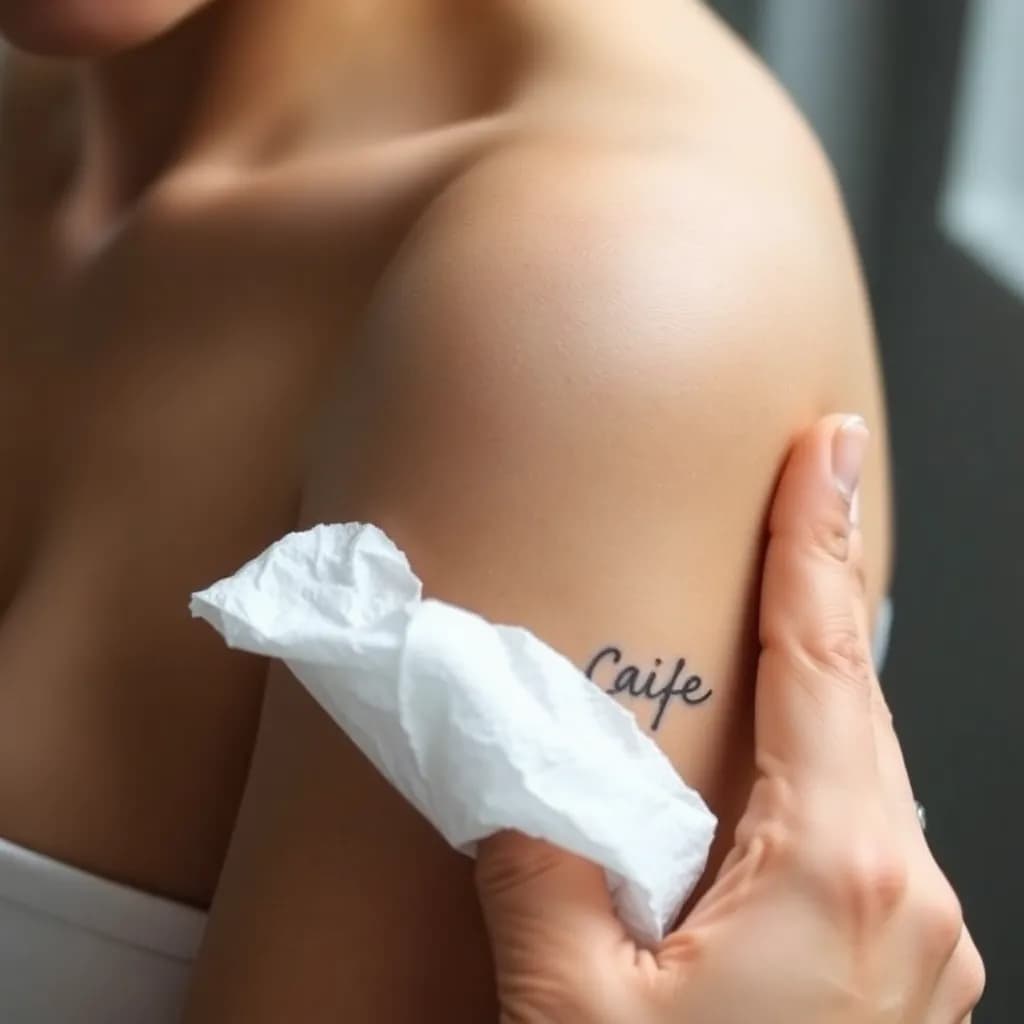 Tattoo gentle washing technique
Warning Signs of Infection: When Peeling Isn't Normal
Most things that look scary in week one are normal healing. Infection is still real, and catching it early prevents bigger problems.
Normal vs. Abnormal: A Side-by-Side Comparison
| Normal Healing | Possible Infection |
|---|---|
| Mild redness close to tattoo edges | Redness spreading outward from tattoo |
| Slight warmth in the first days | Hot to the touch |
| Clear or light ooze in the first days | Thick yellow, green, or cloudy discharge |
| Mild pain that improves day by day | Pain that gets worse instead of better |
| No odor or a mild skin smell | Foul, unpleasant odor |
| Feeling normal overall | Fever, chills, or feeling ill |
| Thin scabs in heavy areas | Widespread thick scabs with fluid |
Specific Infection Warning Signs
Cleveland Clinic lists fever, skin that is hot to the touch, a foul odor or a lot of drainage, pain that gets worse, and red streaks spreading from the tattoo as signs of infection (Cleveland Clinic, 2026). In detail:
1. Spreading redness
- Redness that extends past the tattoo
- A red border that keeps growing day by day
- Red streaks running away from the tattoo
Poison Control notes that redness extending beyond the tattoo means an infection is spreading (Poison Control). Draw around the edge with a pen if you are unsure, and check it again the next day.
2. Heat
- The tattoo feels clearly hotter than the skin around it
- Warmth that increases instead of fading after the first few days
3. Discharge
- Thick, cloudy fluid (yellow, green, or brown)
- Fluid that keeps coming back after you clean it
- Crusts that stay wet or weeping instead of drying
4. Increasing pain
- Pain that should be fading but gets worse
- Sharp or throbbing pain instead of mild tenderness
5. Whole-body symptoms
- Fever
- Chills or sweating
- Feeling generally unwell, with body aches
- Swollen glands near the tattoo
Poison Control says body aches, chills, fever, and swollen glands mean an infection is no longer limited to the skin (Poison Control). Healthline advises seeing a provider right away when symptoms come with a high fever and chills (Healthline, 2019).
Infection vs. Allergic Reaction
Allergic reactions to ink can look like infection, and the FDA notes that the two can share signs (FDA, updated 2024). The FDA describes allergic reactions as rare but hard to deal with, because the pigment is hard to remove. It also notes that people can react to tattoos they have had for years.
A reaction often shows as a red, bumpy, itchy rash (Cleveland Clinic, 2026), sometimes only in one color. Poison Control says an itchy, scaly rash can appear months or years after the session, and advises medical care if a reaction lasts more than a week or two. Seek care right away for intense swelling, hives, dizziness, or trouble breathing (Poison Control).
You do not need to tell them apart yourself. A doctor can, and the treatment is different. Ask your studio for the ink brand, color, and batch if you can, because it helps the doctor.
Common Causes of Infection
Tattoo infections usually come from:
- Unsterile equipment. The FDA warns that unsterile needles and equipment can spread skin infections and other diseases (FDA, updated 2024).
- Contaminated ink. The FDA also reports infections from contaminated tattoo inks, which can need long courses of antibiotics.
- Poor aftercare. Touching the tattoo with dirty hands, or dirty bedding and towels.
- Soaking too soon. Pools, hot tubs, lakes, and the sea. See our guide on swimming with a new tattoo for timing.
- A weaker immune system. Diabetes, immune-suppressing medicine, or illness can slow healing.
What to Do If You Suspect Infection
Step 1: Take clear photos in good light, and note when the symptoms started.
Step 2: If you have fever, spreading redness, red streaks, or pus, see a doctor the same day. Do not wait for your artist to reply.
Step 3: For milder doubts, send the photos to your artist. They see healing tattoos every day and can tell you if it looks like normal peeling.
Step 4: Follow medical treatment exactly. Bacterial infections usually need antibiotics prescribed by a doctor.
Step 5: After the infection clears and the skin has healed, your artist can plan a touch-up for any ink lost along the way.
The FDA asks people to report adverse events that may be linked to tattoo ink (FDA, updated 2024). If you are in the US and had a reaction, your doctor can help you file that report.
When to See a Doctor vs. Contact Your Artist
Knowing who to call gets you the right help faster.
Contact Your Tattoo Artist First For:
- Questions about what normal healing looks like
- Worries about how scabs look
- A small bleed from a cracked or snagged scab
- Doubts about a product you are using
- Light spots or patchy areas after the peel
Tattoo artists have seen thousands of tattoos heal. They can often tell normal from abnormal from a photo and give you a clear next step.
See a Doctor (Urgent Care or Primary Care) For:
- Any of the infection signs described above
- Fever, chills, or feeling unwell
- Symptoms that get worse quickly
- A rash, raised bumps, or strong itching, mainly in one ink color
- Red streaks running from the tattoo
- Bleeding that does not stop with gentle pressure
- Peeling or other symptoms that last longer than a month or two
Go to the Emergency Room For:
- Trouble breathing or swallowing
- Intense swelling or hives spreading beyond the tattoo
- High fever with confusion
- Redness that spreads quickly with severe pain
These are rare with tattoos, but knowing when to escalate matters.
Preparing for Your Medical Visit
If you see a doctor about your tattoo:
- Say it is a new tattoo and give the date of the session
- Bring photos from day one and from each day since, if you have them
- List every product you have put on it
- Note when symptoms started and how they changed
- Bring the ink brand and color from your studio if you can get it
- Mention any health conditions and medicines
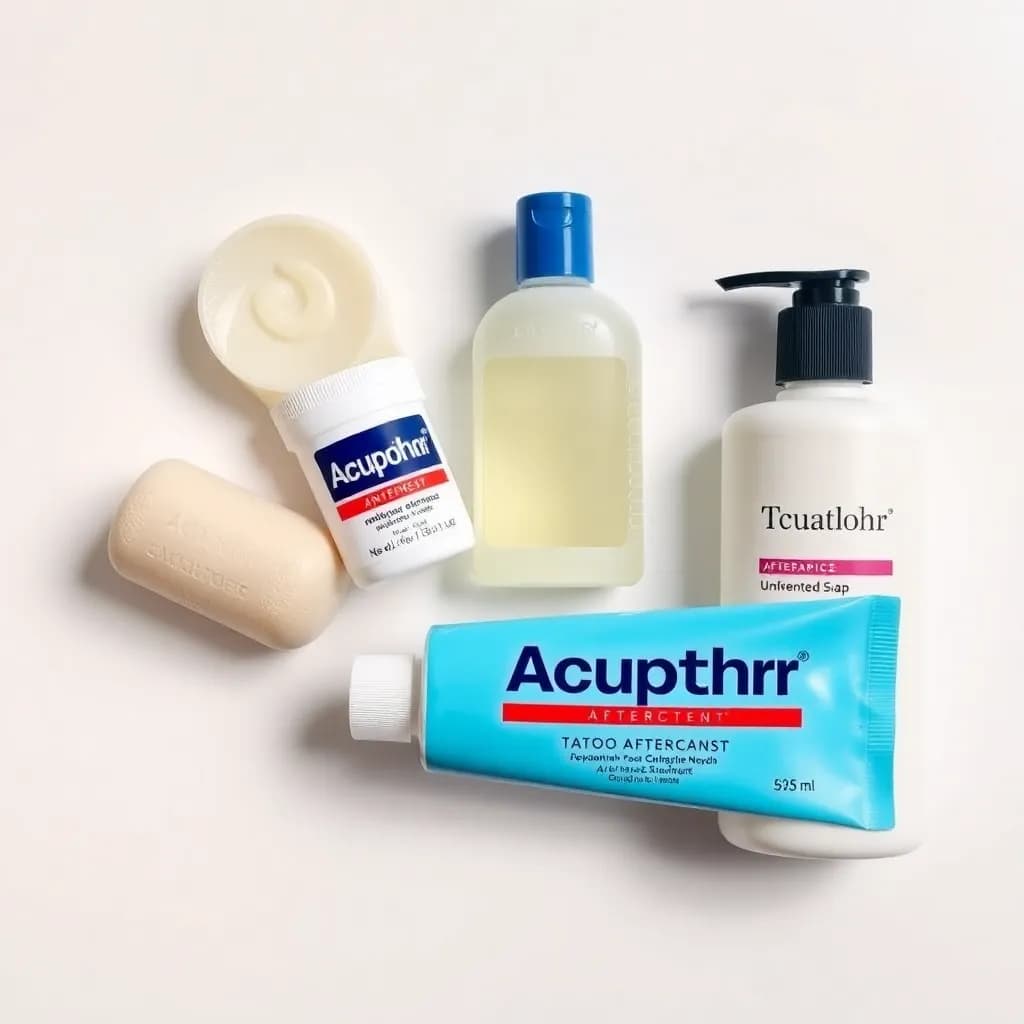 Tattoo aftercare products
After the Peel: Cloudy Skin, Light Spots, and Touch-Ups
When the flakes stop, many people expect the tattoo to look like it did in the studio. It usually does not, at least not yet. The new skin on top looks shiny, waxy, or milky for a few weeks while it settles.
Healthline explains that the dull look comes from the layer of dead skin, not the ink, and that colors should look fresh again after the peel (Healthline, 2019). Give it until the skin feels fully normal before you judge the result. Cleveland Clinic puts the top layer at about two months to heal fully (Cleveland Clinic, 2026).
If you still see light spots, gaps in lines, or uneven color after that, the usual fix is a touch-up. Ask your artist about their touch-up policy before you book. Our tattoo touch-ups guide explains when to book it, what to ask your artist, and how to heal it a second time.
Frequently Asked Questions
How long does tattoo peeling last?
Most peeling lasts about a week, starting around day 3 to 5 and fading by day 14. Large pieces, color packing, and spots that flex or rub can flake longer. Light flaking at the edges into week three is common. If peeling or other symptoms last longer than a month or two, Healthline advises a dermatologist visit.
What is the difference between tattoo peeling and scabbing?
Peeling is thin, dry flakes of dead surface skin, like a sunburn peel, and it covers most of the tattoo. Scabbing is a crust of dried plasma, blood, and ink that forms over the areas with the most trauma, usually dense shading or color. Both are normal when they stay thin and dry. Thick, raised, cracked, or wet scabs are the ones to watch.
Is it normal for ink to come off when my tattoo peels?
Yes. The flakes carry surplus pigment from the upper skin layer, so they can look black or colored. The ink that forms your tattoo sits deeper in the dermis and stays put. The problem is pulling flakes or scabs off early, because that can lift ink from below.
Is it normal for a tattoo scab to bleed after a week?
A small bleed after a week usually means a scab cracked, snagged, or got scratched. Press gently with a clean paper towel, wash, pat dry, and apply a thin layer of moisturizer. See a doctor if the bleeding does not stop, keeps returning, or comes with pus, spreading redness, heat, or fever.
Is it okay if my tattoo isn't peeling?
Yes. Some tattoos peel so lightly that you hardly notice, mainly small or fine line pieces. Medical sources say a lack of peeling is not, by itself, a sign of a problem. Do not scrub the skin to make it peel.
Why does my tattoo look faded or cloudy while it peels?
The new layer of skin on top of the ink is still thin and milky. It blurs the color until it matures. Most tattoos look much brighter once the skin settles. If it still looks patchy after about two months, ask your artist about a touch-up.
Can I put lotion on a peeling tattoo?
Yes. A thin layer of unscented lotion two or three times a day keeps the skin from drying and cracking. Use less if the skin looks shiny or greasy. Follow your artist's product advice, since it matches how they work.
What happens if I accidentally pick off a scab?
Gently wash the area, pat it dry, and apply a thin layer of unscented lotion. The spot may heal lighter, which a touch-up can usually fix. Keep your hands off it from then on, and watch for signs of infection over the next few days.
Conclusion: Trust the Process (But Know the Warning Signs)
Tattoo peeling and scabbing are ugly, itchy, and stressful, but they are temporary and necessary. Your body knows how to heal. Your job is to support that and not interfere.
The key points:
- Don't pick, scratch, or peel. Let everything fall off on its own.
- Keep it clean. Wash gently twice a day through the peel.
- Moisturize thinly. Thin layers, not thick ones.
- Watch for warning signs. Spreading redness, heat, pus, worse pain, or fever mean a doctor visit.
- Be patient. Visible peeling ends in about two weeks, but the skin needs weeks to months to fully mature.
Most of what people worry about during the peel is normal. The tattoo that looks patchy and dull on day 10 usually looks clear and crisp a few weeks later, if you let it heal.
If you are already planning your next piece, you can use our AI Tattoo Generator to try out ideas and bring concepts to your artist. It helps you explore designs, and your artist turns them into a tattoo that works on skin.
Need the earlier healing stages? Our complete tattoo aftercare guide covers day-by-day care from bandage removal through the peeling phase and beyond.