 Francesco Chiaramonte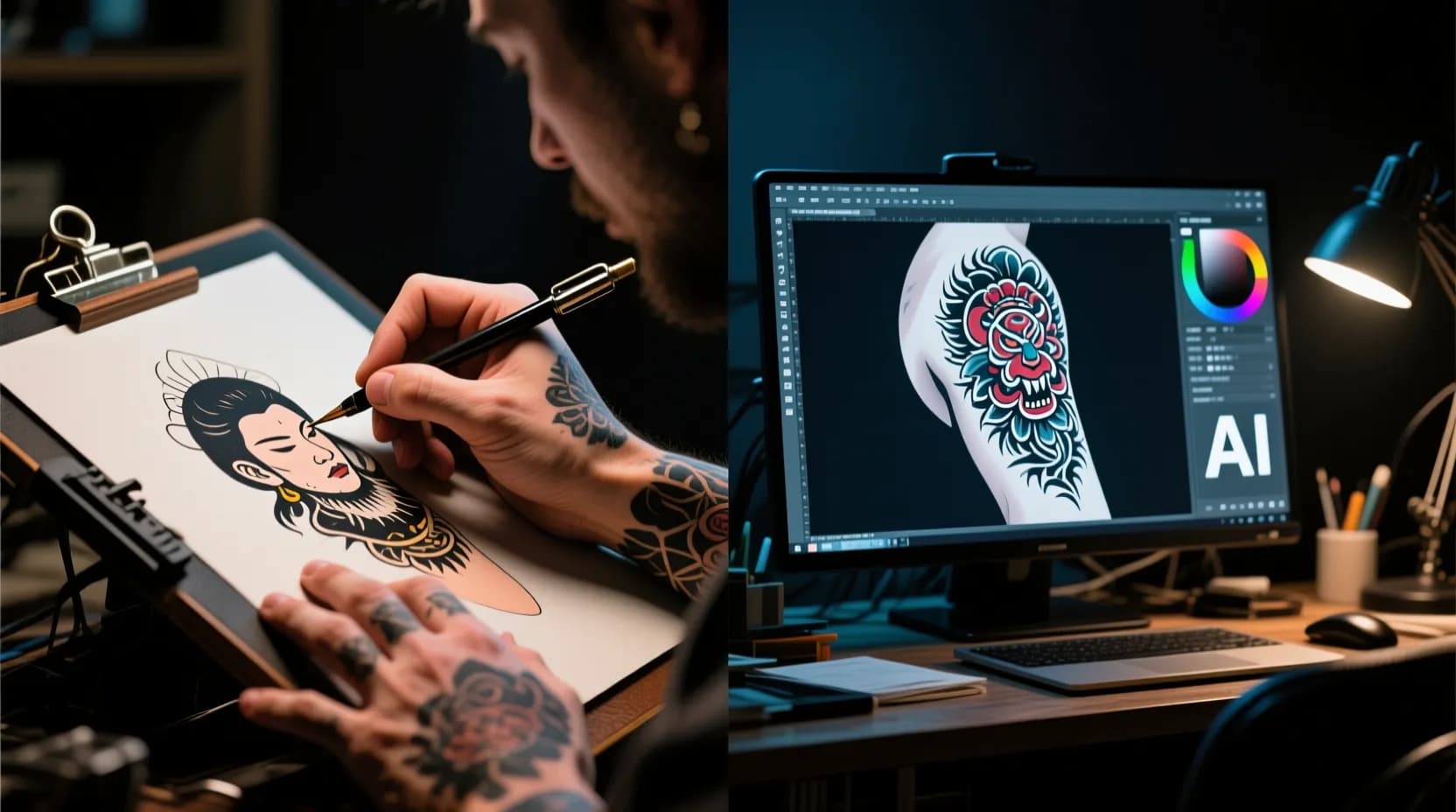
Let's address the elephant in the room: AI is transforming the tattoo industry, and people have strong opinions about it.
Some tattoo artists embrace AI as a time-saving tool. Others see it as a threat to their craft. Clients wonder if they should use an AI tattoo generator or go straight to an artist. The internet is full of heated debates, but most miss the nuance.
Here's the reality: AI and human tattoo artists aren't competing for the same job. They excel at completely different things. Understanding what each does best helps you get better tattoos—whether you use AI, work with an artist, or (ideally) combine both.
This guide breaks down the honest strengths and limitations of each, based on what we've learned from thousands of AI-generated designs and conversations with working tattoo artists.
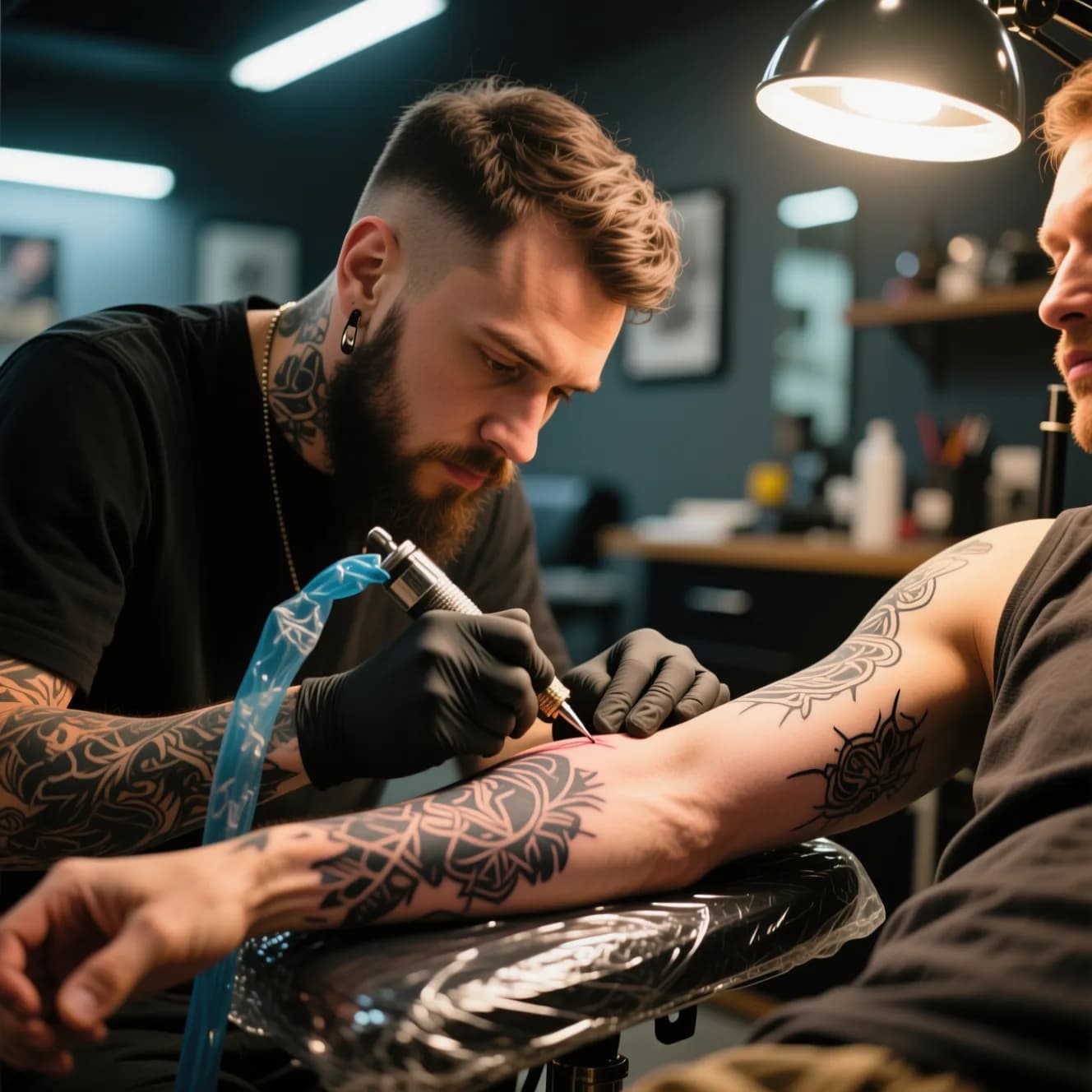 Human tattoo artist working on client in professional studio
What AI Tattoo Generators Actually Do
Before comparing AI to human artists, let's be clear about what AI tattoo tools actually are—and aren't.
An AI tattoo generator is a design tool. You describe what you want in words, and it creates visual concepts based on millions of images it was trained on. Think of it like a visual brainstorming partner that never runs out of ideas.
What AI produces is a design concept—a 2D image that shows what a tattoo might look like. It doesn't:
- Understand how ink behaves in skin
- Know how designs wrap around muscle and bone
- Account for how tattoos age over decades
- Create physical stencils ready for application
- Actually tattoo anyone
This distinction matters because much of the AI vs artist debate conflates "design" with "tattooing." They're related but separate skills.
Where AI Excels: The Honest Strengths
1. Unlimited Visual Exploration
Human artists charge for their time—as they should. If you want five different concepts for your sleeve, that's hours of their work before needle ever touches skin.
AI removes that friction entirely. You can generate dozens of concepts in minutes, exploring directions you'd never have considered. Want to see that rose in traditional, neo-traditional, minimalist, and geometric styles? Four prompts, four images, maybe two minutes.
This isn't about replacing artist consultations—it's about coming to those consultations better prepared.
2. Translating Vague Ideas into Visuals
Many people know they want a tattoo but struggle to articulate their vision. "Something with nature but also geometric, kind of mystical" is hard for even the best artist to interpret from words alone.
AI bridges that gap. You can throw imprecise descriptions at it and see what comes back. The output might not be perfect, but it often reveals what you actually want—or don't want. It's a visual conversation with yourself.
3. 24/7 Availability and Zero Judgment
You can experiment with AI at 3 AM without anyone judging your wilder ideas. Want to see what a tattoo of your cat dressed as Napoleon would look like? Go for it. Curious if a design you're embarrassed to describe out loud would actually work? Try it privately first.
This low-pressure exploration is valuable. Many great tattoos start as "dumb ideas" that turn out to be brilliant.
4. Consistent Style Execution
AI trained on specific styles produces remarkably consistent outputs within those styles. When you prompt for "American traditional eagle," you get designs that follow traditional conventions reliably.
For learning what different tattoo styles actually look like—and which resonate with you—AI is an excellent teacher.
5. Speed for Professional Workflows
Some tattoo artists are embracing AI as part of their process. As one artist explained to SAS Voices: "What used to take hours can now be done much quicker, letting me focus on the tattooing itself."
For artists who want to offer clients more concepts without spending hours on preliminary sketches, AI accelerates the early creative phase.
Where Human Artists Are Irreplaceable
1. Understanding Skin as a Medium
This is the fundamental difference: AI generates images. Tattoo artists understand a living, three-dimensional, aging medium that happens to be attached to a human body.
Great tattoo artists know:
- How ink settles in different skin types and tones
- Where to place designs so they complement body movement
- What line weights will remain readable in 20 years
- How colors shift over time and under different conditions
- When to refuse a design that looks good on paper but will look bad on skin
AI has no concept of any of this. It doesn't know that super-fine lines blow out, that certain placements distort with muscle movement, or that some areas hurt too much for the level of detail requested.
Don Richards, a London tattoo artist, puts it bluntly: "The images are almost always un-tattooable, with levels of detail that are impossible on real skin, and bits in the design that don't look right or make sense."
2. The Actual Tattooing
This seems obvious but bears stating: AI cannot tattoo you.
Even if a robot could technically apply ink—and we're nowhere close to that—would you want it to? The physical act of tattooing requires constant human judgment. The artist reads your skin in real-time, adjusts pressure, responds to how you're handling the session, makes micro-decisions about line placement.
Tattooing is a live performance, not a print job.
3. Consultation and Collaboration
The best tattoo experiences involve deep collaboration between artist and client. A great artist:
- Asks questions that reveal what you actually want (not just what you said)
- Pushes back on ideas that won't age well
- Suggests modifications that improve the design
- Reads your emotional state and adjusts accordingly
- Creates something that tells your story, not just reproduces an image
As Sean Colgrave notes: "It's often joked that being a tattoo artist is also being a therapist, and it's kinda true. AI will never replace that human element."
4. Original Artistic Vision
AI generates based on patterns in its training data. It cannot create something truly new—only recombine existing elements in novel ways.
Human artists bring their unique perspective, developed through years of practice, personal experiences, and artistic philosophy. A tattoo by a distinctive artist carries their artistic DNA. It's original in a way AI fundamentally cannot be.
"AI goes for the middle ground and the generic—that isn't where true art lies, it's in the fringes," Colgrave explains. "There is a piece of the artist in great art, some emotion or feeling that a machine could never feel."
5. Accountability and Relationship
When you commission a tattoo from a human artist, you enter a relationship. They stand behind their work. If something needs adjustment, they're there to fix it. If you want to build on it later, they know the piece intimately.
AI has no memory of your project, no stake in your satisfaction, no reputation built on your referrals. The human relationship—artist to collector—is part of what makes tattoos meaningful.
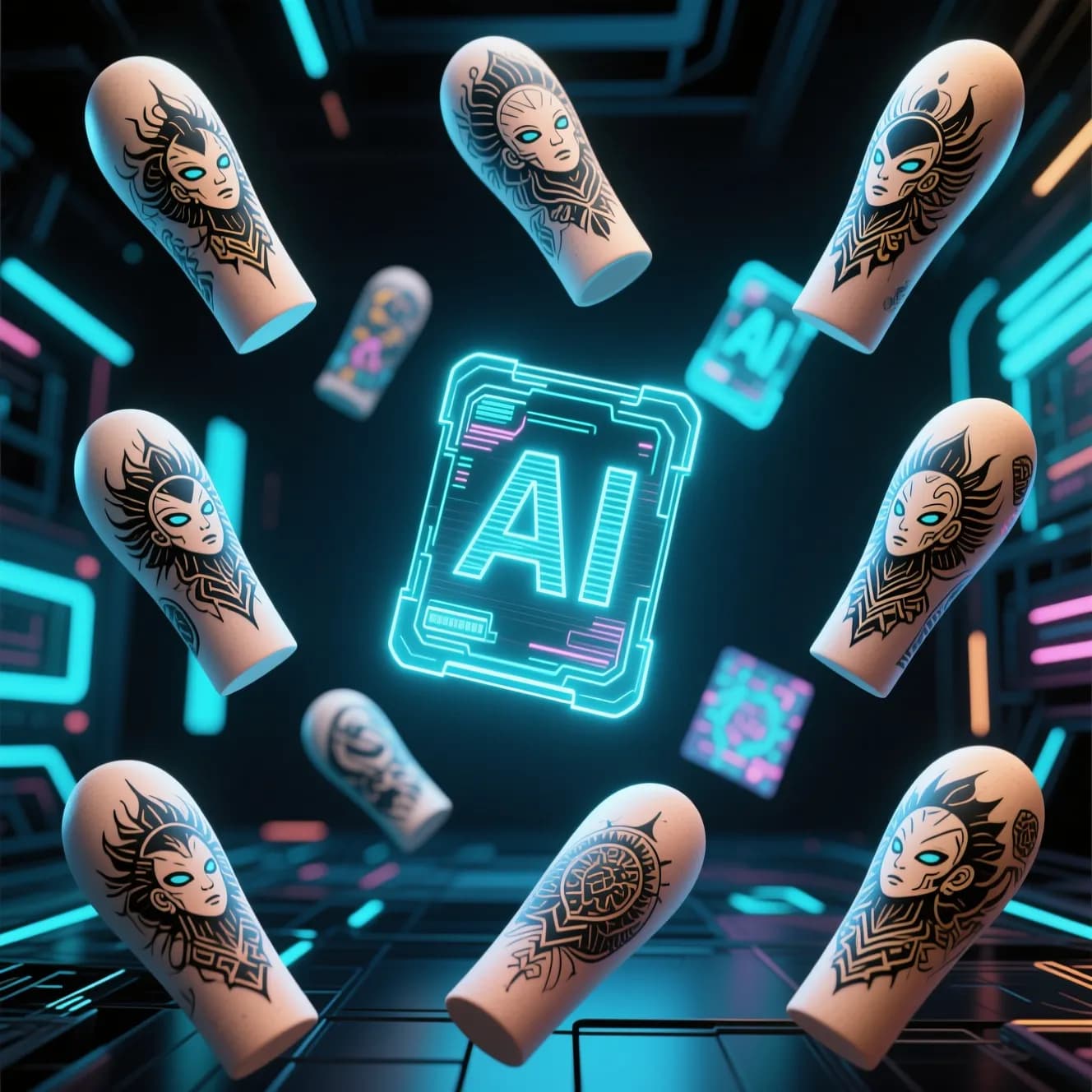 Various AI-generated tattoo designs showcasing different styles
The Realistic Middle Ground
Here's what the polarized debates miss: the best outcomes often come from using both.
AI as a Starting Point, Artist as Finisher
The most productive workflow we've seen:
- Use AI to explore what you want. Generate concepts, try different styles, find what resonates.
- Bring those to a consultation as references—not as final designs.
- Let the artist redesign based on their expertise, your conversation, and the realities of tattooing.
- Trust the process as they translate a concept into something that will work on your body for decades.
This respects what each does well. AI excels at rapid visual exploration. Artists excel at making those concepts real in a permanent medium.
What Artists Think (It's Not All Negative)
We've talked to many tattoo artists, and the range of opinions is wider than the internet suggests.
Apz, a Manhattan-based tattoo artist who created his own AI tool, sees it positively: "These tools facilitate faster collaboration between tattoo enthusiasts and artists during the tattoo process." His AI tool has had over 150,000 interactions helping clients clarify their ideas before booking.
Others are more cautious. Some worry about clients bringing in AI images with unrealistic expectations. Others simply prefer traditional consultation processes.
The common thread: artists who use AI treat it as a tool, not a replacement. They heavily modify AI outputs, use them for inspiration rather than final designs, and maintain their artistic voice throughout.
Common Mistakes When Using AI for Tattoo Design
1. Treating AI Output as Ready-to-Tattoo
AI images are concepts, not stencils. Taking an AI image directly to an artist and saying "tattoo this exactly" often leads to problems:
- Details that won't translate to skin
- Proportions that don't fit your body
- Technical issues the artist has to solve anyway
Better approach: bring AI images as "I like the direction of this" references, not blueprints.
2. Expecting AI to Replace Consultation
Some people skip artist consultations entirely, thinking AI did the design work. But the consultation is where you discover things like:
- The design needs to be larger to read properly
- That placement will distort when you flex
- A different style would age better on you
- There's a personal story element that could make it more meaningful
AI can't have that conversation.
3. Choosing Designs Based on Screen Appeal
AI images are optimized to look good on screens—perfect lighting, ideal angles, no skin texture. What pops on Instagram might underwhelm on skin.
Human artists help you choose designs that work in reality, not just on pixels.
4. Undervaluing Artist Expertise
If you've used AI to "do the hard part" of designing, it's tempting to undervalue the artist's contribution. But the artist is doing the hard part: translating a 2D concept into a living, lasting piece of art on a three-dimensional, moving, aging human body.
Respect that expertise—in communication, in payment, and in creative trust.
How AI Is Actually Being Used Today
The reality of AI in tattooing is more nuanced than either cheerleaders or critics suggest.
By Clients
Smart clients use AI for:
- Exploration before knowing what they want
- Creating reference images to show artists
- Comparing how designs look in different styles
- Building mood boards for tattoo concepts
- Visualizing how custom ideas might look
They don't use it to replace artist consultation or as final designs.
By Artists
Some artists use AI for:
- Quick concept sketches for client discussions
- Breaking creative blocks
- Exploring variations before committing to hand-drawing
- Building Pinterest-style inspiration boards
Most who use it treat AI output as a "rough draft" that gets substantially reworked.
Matt Stone, a Florida tattoo artist, describes it: "Being a creative, you often go through a lot of wild rough drafts before you find a composition you really like, and AI just helps you find that so much faster, so you will have a lot more time to work on stylizations and details."
Industry Trends
We're seeing:
- More tattoo-specific AI tools with features like style selection and body placement previews
- Artists listing "AI-assisted design" as a service offering
- Shops using AI for quick concepts during walk-in consultations
- Growing discussion about disclosure (should clients know if AI was involved?)
The industry is still figuring out norms, but AI isn't going away.
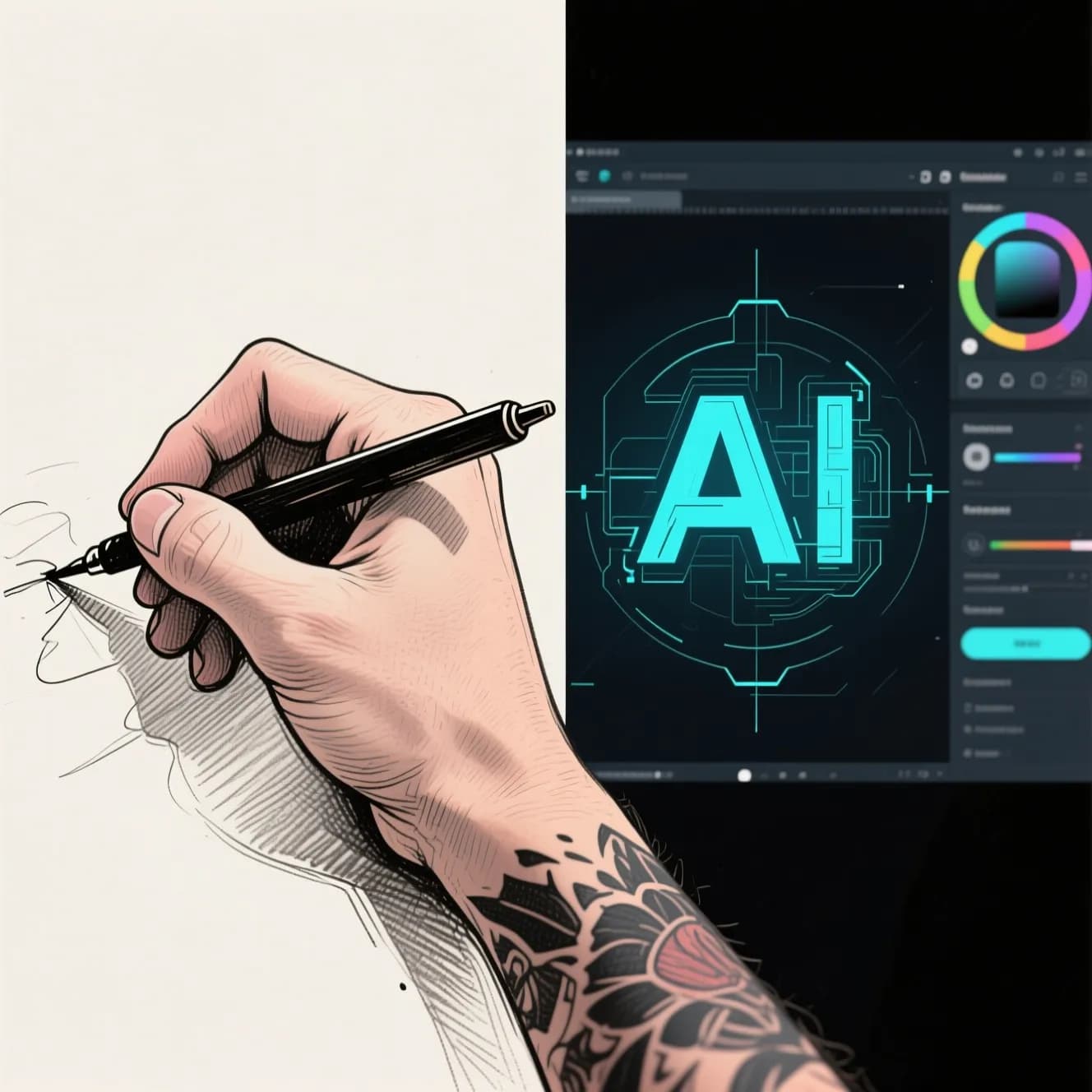 Split view showing human artist drawing vs AI generating tattoo design
The Future: Coexistence, Not Replacement
Will AI replace tattoo artists? No. Here's why:
Tattooing is inherently physical and relational. The act of putting permanent art on someone's body requires human judgment, physical skill, and interpersonal connection that machines can't replicate.
The value of tattoos is in meaning. A tattoo's significance comes from its story, its creation process, the artist who made it, the moment it was done. AI can't provide that meaning—only humans can.
Human creativity evolves; AI recombines. As Apz observes: "The most valuable art will always be the most authentic one, and you will only find authenticity in humans and nature."
What we'll see instead:
- AI becoming a standard tool in the design phase
- Artists differentiating on their human skills
- Clearer workflows that combine AI efficiency with artist expertise
- More clients arriving at consultations better prepared
- Ongoing debate about authenticity and credit
Making the Right Choice for Your Tattoo
Use AI When You:
- Don't know what you want yet
- Want to explore many options quickly
- Need to visualize a vague concept
- Want to compare different styles
- Are preparing references for an artist consultation
Try our AI Tattoo Generator to explore your ideas.
Go Straight to an Artist When You:
- Have a clear vision you need realized
- Want custom art designed specifically for you
- Need advice on placement and sizing
- Want a relationship with the artist
- Are ready to commit to a design
Combine Both When You:
- Want the efficiency of AI exploration plus the expertise of artist refinement
- Have concepts but need them made tattoo-ready
- Want multiple options without multiple consultation fees
- Are working with an artist who welcomes AI references
Frequently Asked Questions
Can AI fully replace tattoo artists?
No. AI generates design concepts, but tattoo artists bring irreplaceable skills: understanding skin as a medium, performing the physical tattooing, adapting designs to individual bodies, and the interpersonal consultation process. The two serve different functions.
Should I show my tattoo artist AI-generated images?
Yes, but frame them correctly. Bring AI images as "I like this direction" references, not "tattoo this exactly." Most artists welcome references that help them understand your vision—as long as you're open to their professional modifications.
Do tattoo artists hate AI?
Opinions vary widely. Some embrace it as a time-saving tool, others see it as a threat to the craft, and many fall somewhere in between. Artists who use AI typically treat it as one tool among many, not a replacement for their skills.
Are AI tattoo designs safe to use?
AI designs are concept images, not vetted tattoo stencils. They may contain details that won't translate to skin, proportions that won't fit bodies, or elements that will age poorly. Always have a human artist review and adapt any AI design before tattooing.
Will AI-generated tattoos look generic?
Potentially, if you use them directly without artist input. AI generates based on patterns in its training data, which tends toward the popular and common. Original, distinctive tattoos still require human artistic vision—either in modifying AI output or creating from scratch.
Is it ethical to use AI for tattoo design?
This is an ongoing debate. Concerns include: AI trained on artist work without consent, clients undervaluing artist labor, and potential loss of uniqueness in tattoo culture. Using AI as part of your process while fairly compensating the human artist who makes your tattoo real is a reasonable approach most can agree on.
The Bottom Line
AI and human tattoo artists aren't in competition—they do fundamentally different things. AI excels at rapid visual exploration, helping you discover and refine what you want. Human artists excel at turning concepts into permanent, living art on your body.
The best tattoos often involve both: AI for exploration, artists for execution. Understanding what each does best lets you use both wisely.
Your tattoo is permanent. Use every tool that helps you get it right—including the irreplaceable tool of a skilled human artist who cares about your piece.
Ready to explore your tattoo ideas? Start with our AI Tattoo Generator to discover your vision, then bring your concepts to a trusted artist for the real thing.