 Francesco Chiaramonte
Why are tattoos so expensive? Because the price you pay covers far more than the hour the needle is running. A typical studio keeps 30% to 50% of each session, the artist pays for single-use supplies and self-employment taxes out of the rest, and a large share of the work (consultation, drawing, setup, cleanup) happens outside the chair and is not billed. In 2026, hourly rates for experienced US artists commonly run from about $130 to $400, depending on skill and city.
Below I break a $500 tattoo into its parts, list what the consumables actually cost, show how rates change by experience and city, and explain why the cheapest option often costs the most later. I have marked which numbers come from sources and which are my own illustrative arithmetic.
Where the Money Goes: A $500 Tattoo Broken Down
Most tattoo artists work as self-employed contractors, not employees. Commission-split shops typically take 30% to 50% of session revenue, which leaves the artist with 50% to 70% (Tommy's Supplies, May 2026). The artist then pays for supplies and taxes from that share.
Here is an illustrative $500 tattoo at a 40% shop split. The split and the tax set-aside come from the source above. The supply figure is my own round estimate for a small-to-medium piece, so treat it as a placeholder.
| Line item | Amount | Note |
|---|---|---|
| Price you pay | $500 | Before tip |
| Shop commission (40%) | -$200 | Rent, utilities, front desk, sterilization, marketing |
| Artist's share | $300 | 60% of the price |
| Supplies and consumables | about -$20 | My estimate, see the price list below |
| Tax set-aside (25% to 30% of net) | about -$70 to -$84 | Self-employment tax alone is 15.3% |
| Left for the artist | about $196 to $210 | Before insurance, health care, equipment, education |
That remaining figure has to cover every hour spent on the piece, not only the chair time. If the tattoo took three hours in the chair and two hours of drawing and prep, the artist earns roughly $40 an hour before paying for their own equipment, health care, and slow weeks. Artists who rent a booth instead pay a flat fee (one source cites $600 a week as an example) and keep the whole session price, but the rent is due whether or not the calendar is full.
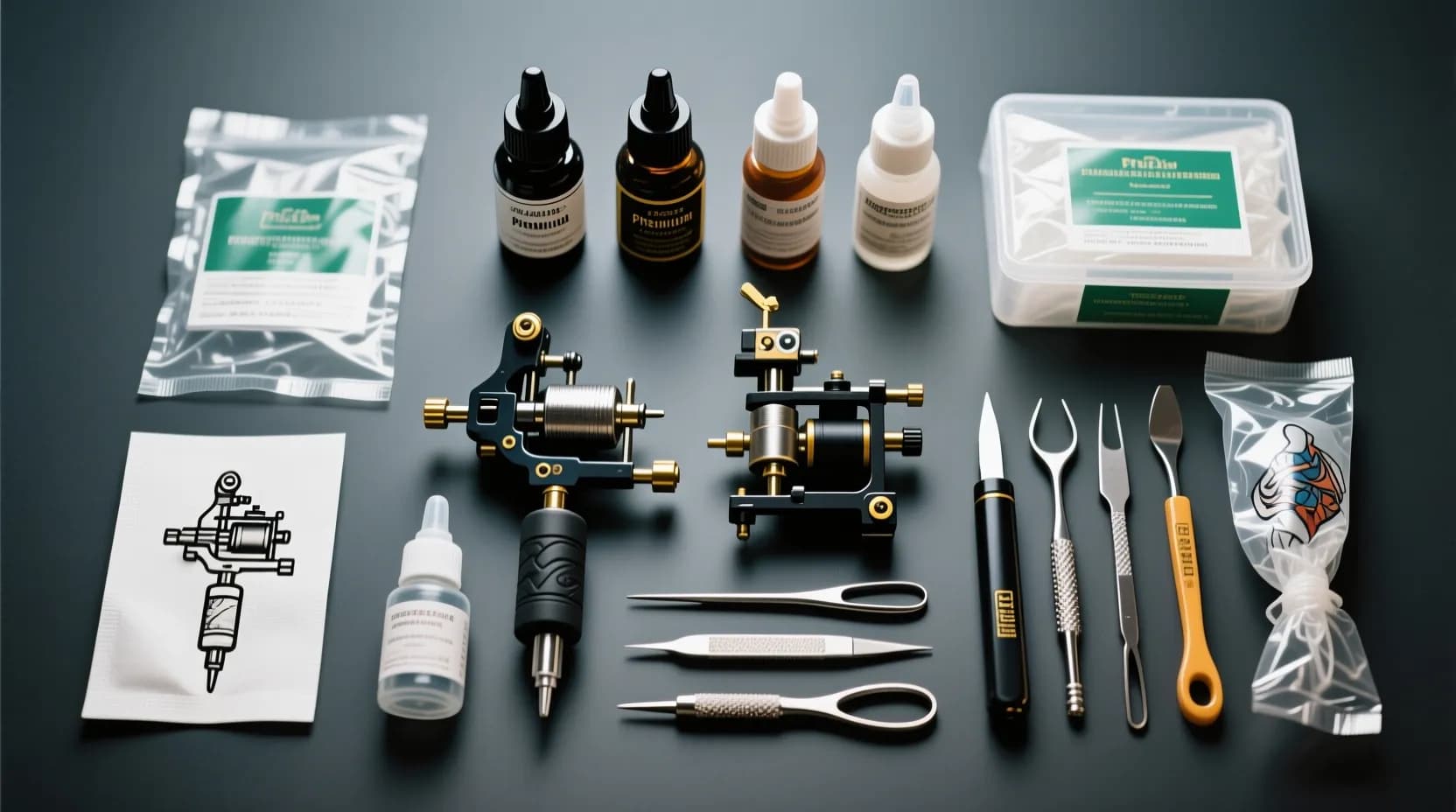 Professional tattoo equipment and supplies showing quality tools and materials
What Tattoo Supplies Actually Cost
Consumables are a small part of the price per tattoo, but they are non-negotiable. Every needle, glove, and ink cap is single-use and medical-grade. Here are listing prices I found from supply retailers. Prices change, and these are snapshots, not quotes.
| Item | Listed price | Source |
|---|---|---|
| Round liner cartridges, box of 20 | $13.99 to $16.99 (other brands $17.99 to $19.99) | World Wide Tattoo Supply |
| Tattoo ink, 1/2 oz bottle | about $7.00 for one brand; specialty sets from $85.50 | World Wide Tattoo Supply, Tommy's Supplies |
| Black nitrile gloves, box of 100 | $7.49 | Ultimate Tattoo Supply |
| Stencil transfer paper, 100 sheets | $15.29 to $18.99 | Walmart listings |
| Tattoo machine and power supply upkeep | $25 to $100 per machine, $50 to $150 per power supply | World Wide Tattoo Supply |
The arithmetic: one cartridge costs under $1, a glove pair costs a few cents, and a stencil sheet costs about 15 to 20 cents. Add barrier film, grip covers, ink caps, wipes, and aftercare wrap, and a single session's supplies still stay modest. I could not find a sourced per-tattoo total, so I do not claim one. The point is that supplies explain a small slice of the price. Time, overhead, and skill explain most of it.
The Time You Are Not Billed For
The chair hour is only part of the job. Before and after the needle, an artist typically spends time on:
- Consultation: discussing placement, size, and style, often by message and then in person
- Reference research and drawing: one artist estimates 4 or more hours of pre-appointment work for a custom piece (Jeremy Furniss)
- Stencil prep and placement: getting the design to sit correctly on a curved body part
- Setup and breakdown: wrapping surfaces, opening sterile supplies, then cleaning and disposing after
- Messages, quotes, and scheduling: the same Furniss article describes working days that can run from 8am to after 10pm
Most artists bill only the time the machine is running, or a flat price that averages it out. That is why a design that looks simple can still carry a large price: the drawing and prep were real labor, and a half-day booking blocks the artist from taking another client.
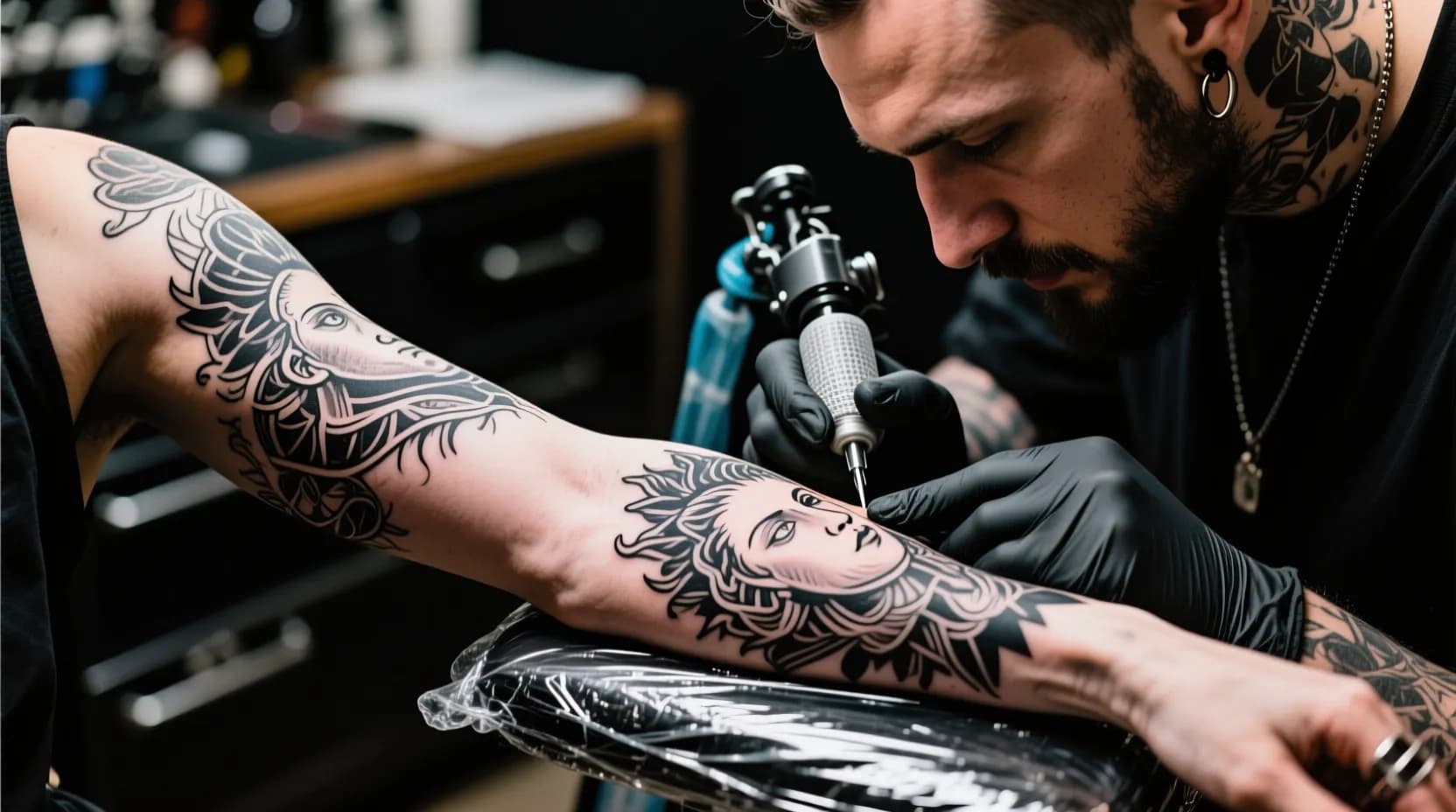 Professional tattoo artist working on detailed tattoo showing time and skill investment
Tattoo Hourly Rates in 2026: Experience and City
Experience moves the rate more than anything else. These US ranges come from Tommy's Supplies' May 2026 pricing guide.
| Artist level | Hourly rate (2026) |
|---|---|
| Apprentice or junior (1 to 3 years) | $80 to $130 |
| Mid-level (3 to 7 years) | $130 to $250 |
| Senior (strong reputation, waitlist) | $250 to $400 |
| Elite | $400+, some $500 to $1,000+ |
City matters too. The same guide says major metros (New York, Los Angeles, San Francisco, Miami, Chicago) run 20% to 40% above the national baseline, mid-tier cities sit near it, and small markets run below it. Its own figure for how far below is inconsistent (10% to 20% in one section, 20% to 30% in another), so I would use a local quote rather than a rule of thumb. Another 2025 guide from Hustle Butter puts established artists at $150 to $250 an hour, with a wider market range of about $100 to $300+.
Shop minimums also vary: typically $80 to $200 across most US markets, with major metros toward the higher end. Sources disagree on exact numbers, so ask the shop directly. For a size-based estimate, try the tattoo price calculator or read our guide on how much a tattoo costs.
How Artists Price: Hourly, Flat, and Day Rates
Quotes come in three common forms, and knowing which one you are getting explains a lot of surprises (Tommy's Supplies, 2026).
- Hourly rate: you pay for chair time. This suits large or multi-session work, but the final total is harder to predict.
- Flat or per-piece price: the artist estimates the full job, including how long it will take, and gives one number. This suits small, well-defined designs and flash.
- Day rate: you book a whole day for large work. It is common for sleeves, backpieces, and out-of-town clients.
Ask which model applies before you book, and ask what happens if the session runs long. A clear answer is a good sign about the artist.
Why the Same Tattoo Costs Different Amounts
Cost of living is one reason. Furniss compares Bali and Perth using Numbeo: about $800 per month for a single person excluding rent in Bali versus $1,300 in Perth, which he calls almost 40% higher. He argues that this gap is why prices differ between countries. The figures come from his article and carry no year, so use them as an illustration of the mechanism rather than as current data.
Other factors that move the quote:
- Color and realism: one guide estimates a forearm piece from a mid-level artist at $400 to $800 for simpler black work and $800 to $1,500 for detailed color or realism (Tommy's Supplies, 2026). Packing color takes longer.
- Placement: ribs, hands, and necks are harder to work on and take more time.
- Custom versus flash: pre-drawn flash is cheaper because the design work is already done.
- Demand: artists with waitlists charge more because their calendars are full.
What You Are Not Paying For
There are two common misconceptions. First, you are not paying the artist's full price as income. As the breakdown above shows, a large share goes to the shop and to taxes. Second, you are not paying for the artist's training as a lump sum. Training is a sunk cost the artist absorbs, but it shows up in the rate through skill and speed. I do not cite apprenticeship costs here because I could not verify a reliable figure, and these vary widely by region and shop.
Licensing, inspection fees, and insurance also vary by state and country, so I do not put a number on them. They are part of shop overhead and are one reason a licensed studio is not interchangeable with someone working from home.
 Clean professional tattoo studio interior showing quality environment
Why Cheap Tattoos Cost More Later
A bargain tattoo is a risk because you cannot return it. Fixing a bad one means paying twice.
- Cover-ups: about 1.5 to 2 times the cost of a fresh tattoo of the same size, because they usually need a larger, darker design (Tommy's Supplies, 2026).
- Laser removal: one 2026 price guide lists per-session prices from $75 to $150 for extra-small tattoos up to $800 to $1,500+ for extra-large ones, with 6 to 12 sessions typical for full removal and sessions spaced 6 to 8 weeks apart (Bookedin, May 2026). Its FAQ estimates that removing a $200 tattoo could cost $600 to $2,000+. That guide cites no external source, so use it as a rough guide only.
- Rework and touch-ups: you may still pay a new artist to repair weak lines. See our touch-ups guide.
To estimate removal for your own case, use the tattoo removal cost calculator. I have not found a reliable sourced number for infection treatment costs, so I leave those out.
How to Save Money Without Going Cheap
Lower the cost with choices, not by haggling over the rate.
- Go smaller or simpler. Fewer lines and less color means less chair time.
- Choose flash. An artist's pre-drawn designs skip the custom design hours.
- Book a less in-demand artist with a strong portfolio. Mid-level artists at $130 to $250 an hour can do excellent work. Judge by healed photos.
- Bring clear references. A concrete idea shortens consultation and redraws. You can generate concepts to discuss with an artist using the Ink Studio AI generator, though those images are ideas, not tattoo-ready stencils, and the artist will redraw them.
- Save for the right artist. Waiting costs less than a cover-up.
- Budget for the tip. See how much to tip a tattoo artist.
To compare local studios, browse the tattoo shop directory.
Frequently Asked Questions
Is $200 an hour normal for a tattoo artist?
Yes, for an experienced artist. Tommy's Supplies puts mid-level US artists at $130 to $250 an hour and senior artists at $250 to $400 in 2026. Hustle Butter gives $150 to $250 for established artists in 2025. Beginners charge less and elite artists charge more.
Why do small tattoos cost so much?
Setup, sterile supplies, stencil work, and cleanup take about the same time for a tiny tattoo as a bigger one. Shops therefore set a minimum, typically $80 to $200 in most US markets. The minimum covers the fixed work, not the ink on skin.
Why do artists charge a minimum?
A booking uses a time slot and sterile single-use supplies even if the tattoo takes ten minutes. The minimum keeps short jobs from losing money. Reputable shops rarely waive it.
Are tattoos more expensive in 2026?
Rates are not falling. The 2026 and 2025 guides I read put typical hourly rates between roughly $100 and $400, depending on experience and city. I did not find a reliable year-over-year dataset, so I cannot give a percentage increase.
Why do color tattoos cost more than black and grey?
Color usually takes more passes and more time. One 2026 guide estimates a medium piece at $150 to $250 an hour as roughly $300 to $600 more for color realism (four to five hours) than for black and grey (about two hours).
Can I negotiate a tattoo price?
Rarely. The rate reflects skill and overhead. A better approach is to change the project, by reducing size, skipping color, or choosing flash, rather than asking for a lower rate. Ask for the quote in writing.
Do I tip on top of the price?
Tipping is customary in the US. See our tipping guide for amounts and etiquette.
Planning Your Tattoo Budget
Get a quote for the exact size and placement, then add a margin for the tip and aftercare. Compare two or three artists on healed portfolio photos, not just rate. Use the tattoo price calculator for a starting range, and bring it to a consultation. A tattoo is permanent, so the cheapest quote is rarely the best value.