 Francesco Chiaramonte
The best tattoo placement matches your design size, your pain tolerance, and how visible you want the tattoo to be. For most people getting a first tattoo, that means the outer upper arm, forearm, outer thigh, or calf: padded areas that hurt less, heal cleanly, and are easy to show or cover. This tattoo placement guide gives you a chart for more than 20 body areas, then walks through pain, aging, visibility, first tattoos, and how to test a spot before you commit.
One note on sources. No peer-reviewed study ranks tattoo pain by body site, so the pain and aging ratings below come from tattoo artists and studio guides, and I name them where I use them. Treat them as a starting point for a conversation with your artist, not a measurement.
Tattoo placement chart: pain, aging, healing and size by body area
This table summarizes what the artist guides I reviewed agree on (Tattooing 101, Obscura Ink, Painful Pleasures, Wild Heart Tattoo, Electrum Supply). Where sources disagree, I went with the more cautious rating. A few cells (for example inner bicep and wrist) rest on my own judgment because the sources say little about them.
| Area | Pain | Visibility | Aging and fading | Healing | Size class | Suits |
|---|---|---|---|---|---|---|
| Outer upper arm | Low | Easy to hide or show | Holds well | Easy | Medium to large | Traditional, realism, portraits |
| Forearm | Low | Often visible | Sun exposure, otherwise stable | Easy | Medium | Script, florals, geometric |
| Shoulder and shoulder blade | Low to moderate | Easy to hide | Holds well | Easy | Medium to large | Florals, wings, large drapes |
| Upper back | Low | Easy to hide | Holds well | Easy, but hard to reach alone | Large | Large scenes, symmetry |
| Outer thigh | Low | Easy to hide | Holds well | Easy | Large | Almost any style |
| Calf | Low to moderate | Often visible | Fairly stable | Easy | Medium | Portraits, vertical designs |
| Lower back | Moderate | Easy to hide | Varies with weight changes | Moderate | Medium to large | Medium pieces |
| Chest | Moderate to high | Easy to hide | Sun exposure, stretch | Moderate | Large | Symmetry, animals, florals |
| Stomach | Moderate | Easy to hide | Stretches with weight change | Moderate | Large | Large pieces (plan around body changes) |
| Hips | Moderate | Easy to hide | Stretch risk | Moderate | Large | Wrapping florals, snakes |
| Inner bicep | Moderate | Easy to hide | Fairly stable | Moderate | Small to medium | Script, small designs |
| Shin | Moderate to high | Often visible | Fairly stable | Moderate | Medium | Linear, geometric |
| Ribs | High | Easy to hide | Breathing movement, some stretch | Moderate | Large or narrow vertical | Script, vertical designs |
| Sternum and collarbone | High | Visible in low necklines | Sun exposure | Moderate | Small to medium | Ornamental, symmetrical |
| Spine | High | Easy to hide | Fairly stable | Moderate | Narrow, long | Linear script |
| Inner thigh | High | Hidden | Higher wear and friction | Slower | Medium | Few styles; many artists advise caution |
| Elbow and knee | High | Varies | Joint movement | Slower, may crack | Small | Simple, bold designs |
| Armpit | Very high | Hidden | Friction and sweat | Slower | Small | Rare |
| Neck | Moderate to high | Very visible | Sun exposure | Moderate | Small to medium | Bold or delicate |
| Wrist | Moderate | Often visible | Fades faster | Moderate | Small | Simple lines |
| Ankle and foot | High | Easy to hide in shoes | Shoe friction, fades faster | Slower | Small | Simple designs |
| Hands and fingers | High | Very visible | Fades fastest | Slower | Small | Bold, simple designs |
| Behind the ear | Moderate to high | Hidden by hair | Varies | Moderate | Small | Delicate and fine-line |
Size classes follow Tattooing 101's grouping: small spots include the wrist, ankle, behind the ear, and top of the foot; medium spots include the forearm, calf, shin, and upper arm; large spots include the upper thigh, back, chest, stomach, hip, and ribs; extra-large canvases combine areas, such as a full sleeve or a full back. Pain tiers follow the lists in the studio guides above, and the placement-specific notes in the sections below explain why.
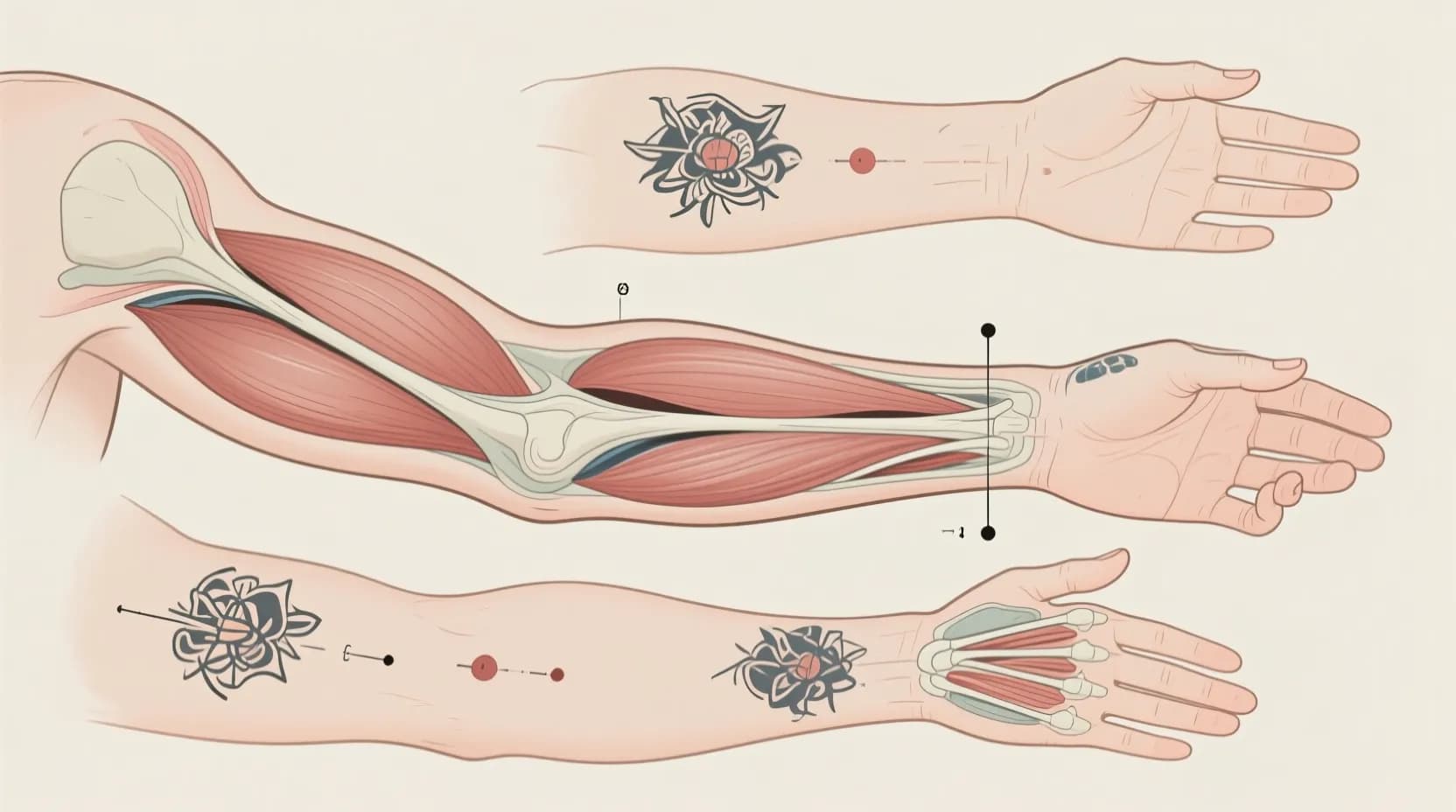 Arm tattoo placements showing bicep, forearm, wrist, and hand areas
Why tattoo placement matters
Placement decides four things before the design does: how much the session hurts, how the tattoo ages, how it heals, and who sees it. Painful Pleasures puts it simply: tattoo placement is the position of a design on the body based on anatomy, movement, size, visibility, and long-term wear, and it affects how the tattoo flows with muscles and joints.
A strong design in the wrong place falls flat. Electrum Supply gives an example: a detailed eye tattoo that looks right on an inner bicep can look smushed on the side of the neck, because the design warps as the neck turns. Pick the spot with the design in mind, or adapt the design to the spot.
Tattoo pain map: where it hurts least and most
Pain depends on nerve density, skin thickness, and how close bone sits to the surface. Obscura Ink's artist sorts areas this way: ribs, sternum, spine, armpits, and knees are high-pain; upper arms, thighs, calves, and shoulders are moderate; forearms, outer shoulders, and outer thighs are low. Tattooing 101 adds that the Adam's apple area of the neck can feel worse because the artist stretches the skin there.
Lowest-pain areas
The outer thigh, outer bicep, forearm, outer shoulder, calf, and upper back (away from the spine) show up as the easy ones across Electrum Supply, Obscura Ink, and Painful Pleasures. They have more muscle or fat padding and sit away from bone.
Highest-pain areas
Ribs, sternum, spine, armpits, hands, feet, ankles, elbows, knees, neck, and the face are the usual list. Thin skin, bone close to the surface, and dense nerves explain most of it. Ribs add a second problem: every breath moves the area while the needle works.
What actually predicts how much it hurts
Location is only one part. A 2020 survey of 1,092 people tattooed in Poland (Witkoś and Hartman-Petrycka, International Journal of Environmental Research and Public Health) found that longer session time, higher stress, and bleeding were the strongest predictors of pain. The same study found women and men reported similar pain intensity during tattooing, though women reported higher pain right after the session.
The practical point is session length. A 45-minute tattoo on a "painful" spot can be easier to get through than an 8-hour session on a "painless" one. Tattooing 101 makes the same argument: an hour or less is much easier to tolerate than a long session. Ask your artist about breaks if a long session is planned.
Which tattoo placements age best
Skin that stays stable, sees less sun, and rubs against less clothing holds ink best. Painful Pleasures lists the upper arms, back, shoulders, and outer thighs as generally longer-lasting areas. Wild Heart adds that the back, shoulders, forearms, and shins hold their shape well because the skin is tighter and less affected by body changes.
The areas that fade or distort faster are the ones used constantly or stretched:
- Hands and fingers: Tattooing 101 notes that because we use our hands all the time, the ink fades much faster there. Wild Heart says the skin regenerates faster and endures more friction, so hand and foot tattoos will almost certainly need more frequent touch-ups.
- Feet and ankles: Shoe and sock friction, plus a slower, fiddlier heal.
- Inner thighs: Painful Pleasures files them under higher wear and fade.
- Stomach, hips, and sometimes the chest: Skin that stretches with weight change, pregnancy, or muscle gain can distort a design over time.
- Forearms and chest: Sun is the usual culprit, which is why SPF belongs in your routine. See tattoo touch-ups for what a refresh involves.
Fine lines and small details blur everywhere over the years. Electrum Supply warns that a highly detailed tiny tattoo can age into an inky blur, so give detail room. That rule matters most in high-wear spots.
Placement and healing difficulty
Some spots simply heal easier. Obscura Ink says upper arms, forearms, calves, and the back are easy to keep clean and less likely to rub against clothing. Hands, fingers, feet, ankles, elbows, and knees heal slower, and the tattoo may scab, peel, or crack more because of constant use, washing, friction, or joint movement.
Reach matters too. Electrum Supply points out that back tattoos can be tricky to heal because you cannot apply aftercare products thoroughly on your own, so plan for a partner or friend to help. A foot tattoo makes showering and wearing shoes harder. If your life includes work gear, tight waistbands, or a daily run, think about what rubs the new tattoo for two weeks. The complete tattoo aftercare guide covers the day-by-day routine, and the notes on peeling and scabbing help you tell normal from not normal.
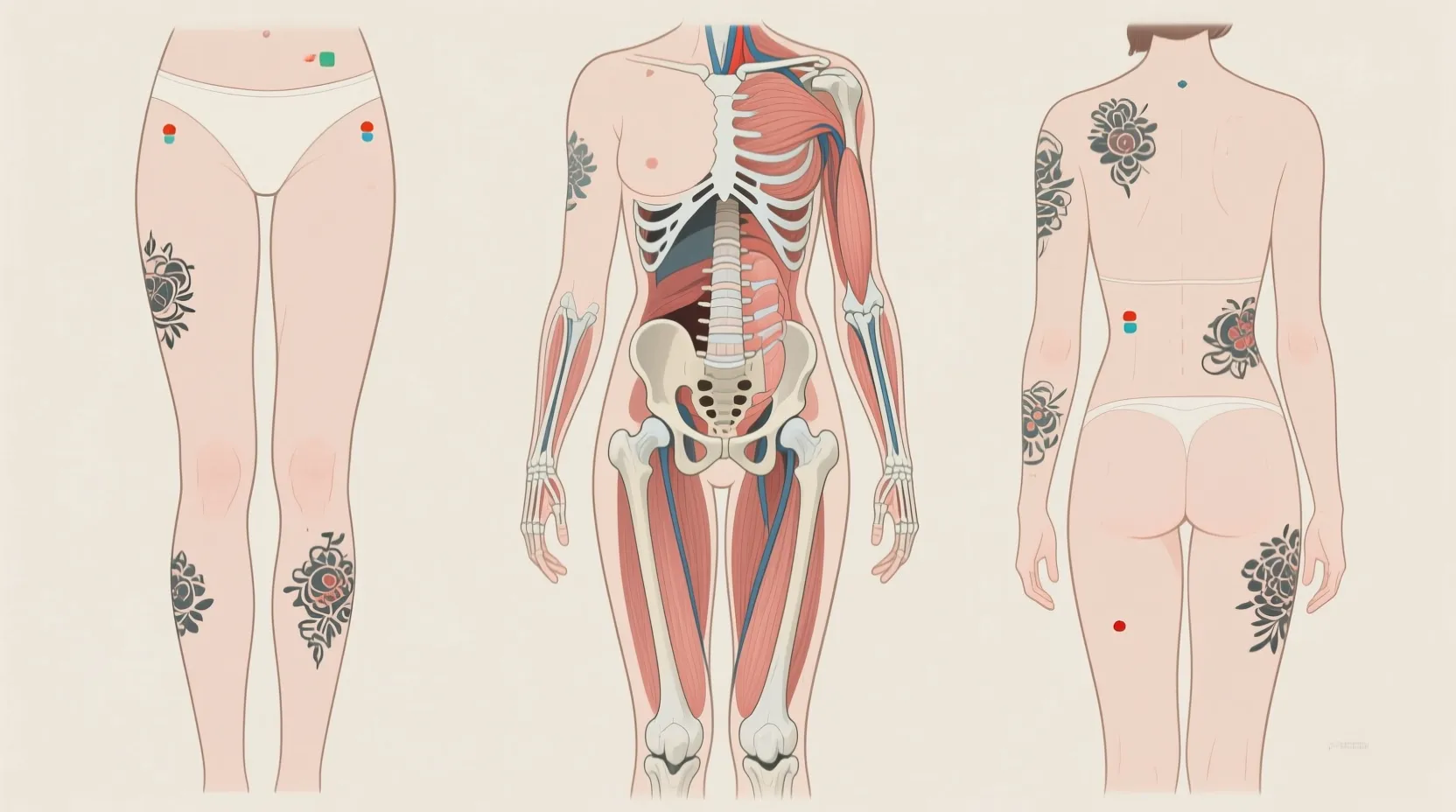 Leg and torso tattoo placements showing thigh, calf, chest, and back areas
Match your design size to the placement
Size is the most common reason a design fails in a spot. Tattooing 101 puts it plainly: if you consider each body part its own canvas, a large, detailed Japanese design will not fit a wrist, and if you crammed it in, the lines would blur into a blob over time.
| Size class | Typical spots | Design advice |
|---|---|---|
| Small | Wrist, back of the palm, top of the foot, fingers, ankle, behind the ear, above the elbow, knee | Simple shapes, bold lines, short text |
| Medium | Forearm, calf, shin, neck, shoulder, upper arm, shoulder blade, inner thigh, sternum | Flash, script, florals, long and narrow designs |
| Large | Upper thigh, upper back, lower back, chest, stomach, hip, ribs | More elements, shading, and detail |
| Extra-large | Full sleeve, full leg sleeve, chest plus stomach, full back | Planned with the artist over several sessions |
Source for the size classes: Tattooing 101. The reverse also holds. Painful Pleasures notes that a tiny design dropped in the middle of a huge flat area, like the thigh or back, can feel lost. Tattooing 101 adds that many small tattoos scattered across a large area never look as good as one big piece planned together, though a small tattoo on a large canvas can still work if it follows the body's flow.
If you are shaping a concept with an AI tattoo generator, say where it will go. A design made for a forearm strip needs different proportions than one made for a back panel. The tattoo size calculator gives you a rough idea of how large a design will be on a given area before you talk to an artist.
Tattoo placement by visibility and job
Visibility is a lifestyle decision, so ask what you can live with in short sleeves, a swimsuit, and a job interview.
- Easy to hide: Back, torso, upper thighs, ribs, hips, and shoulders. Wild Heart lists the back, torso, and upper thighs as simple to conceal with clothing, and Electrum Supply adds behind the ear, thighs, and lower chest for small pieces.
- Hidden or shown on your terms: Upper arm and leg pieces can be covered with sleeves or trousers or left visible, according to Electrum Supply.
- Hard to hide: Forearms, hands, neck, and face. Wild Heart says these can influence first impressions in certain professional environments.
Hands, neck, and face are called "job stoppers." Tattooing 101 says tattoos in these areas can limit career opportunities because most corporate jobs do not accept visible tattoos, and that they can lead to being stopped more often at customs and by police or refused entry to some licensed venues. Electrum Supply agrees that face and neck tattoos are still widely considered job stoppers. Attitudes vary by country and industry, so check your workplace policy rather than guessing.
A practical rule for the first few: if a long-sleeve shirt and trousers cover it, you control who sees it. Painful Pleasures also warns that "just a little visible" often turns out to be very visible, so judge a spot by short sleeves and open collars, not by how it looks standing still in a mirror.
Tattooing 101 tells artists to consider advising clients who are not heavily tattooed, or who are very young, against these areas. Save them for later, once you are sure.
Best tattoo placement for a first tattoo
For a first tattoo, choose a spot that is low-pain, easy to heal, and easy to cover if you change your mind: the outer bicep, forearm, outer thigh, calf, or shoulder blade. Tattooing 101 calls the forearm a great first-tattoo spot because it ranks fairly low on the pain scale, and Wild Heart calls the outer shoulder and bicep a good option for first-timers.
Three more rules help:
- Skip bony, thin-skinned spots. Tattooing 101 advises steering first-timers away from ribs, armpits, and bony areas because it is hard to prepare for that pain if you have never felt it.
- Keep the session short. A small or medium piece lets you learn your tolerance and how your skin heals. Wild Heart recommends starting small for that reason.
- Leave room. If you may want a sleeve later, avoid dropping a tiny tattoo in the middle of the forearm or bicep. Tattooing 101 says it will either need to be covered or built into the sleeve.
If you want a hidden first tattoo, Wild Heart suggests the ribs, shoulder blade, side of the thigh, or upper back, though ribs carry the higher pain of the list.
Tattoo placement for women and men
Neither sex has a "correct" spot, and the design decides whether a tattoo reads as bold or delicate. Still, people search this, and the pattern in the sources is about size and style.
Tattooing 101 observes that many women choose placements that follow the body's curves, like a design that starts on the upper or outer thigh and wraps the hip, and small, jewelry-like spots such as the wrist, collarbone or sternum, ankle, and finger. It also notes that men more often choose larger designs, which call for a half sleeve, full sleeve, calf, chest, or back. These are tendencies reported by an educator, not rules.
The 2020 Polish survey above found the same split in what people chose: the torso was picked more often by women and the upper extremity more often by men. It also found that women's designs took less time and caused lighter bleeding, which fits the session-length point in the pain section. Choose the spot you will like looking at in ten years, not the one a stereotype assigns you.
Sleeve placement and flow
Flow means the design follows the body's muscles and curves instead of sitting on top like a sticker. Tattooing 101 gives practical rules: a tattoo should be right side up when you stand with your arms relaxed at your sides, and a face in a design should look forward or inward toward the center line of the body, for example inward on the chest and forward on the outer thigh.
Wrapping designs suit the upper thigh and hip, upper arm, and forearm; vertical and narrow designs suit the ribs, spine, calf, and shin. Tattooing 101 also points out that a forearm piece should not wrap so far around the arm that it overlaps.
If a sleeve is on your list, plan it before the first tattoo goes in. A scattering of small tattoos makes a sleeve harder to design, and even stepping a three-quarter sleeve up to a full one can be tough. Our guide on how to plan a tattoo sleeve covers theme, order, and how to leave gaps for filler.
How to test a tattoo placement before you commit
You can preview most spots in an afternoon.
- Mark it. Draw the design on your skin with a marker. Wild Heart suggests setting it with a light layer of hairspray so it lasts a day or two.
- Print it at real size. Print the design in a few sizes, cut it out, and tape it to the spots you are considering. Wear it around for a day to see how it looks as you move.
- Check the mirror and photos. Take photos from several angles. You will see the tattoo in the mirror more than by looking down at it.
- Try it on a photo. The virtual tattoo try-on tool lets you place a concept on a body photo to compare rough size and position. Our guide to how to try a tattoo before getting it compares the options in more detail.
- Ask for a stencil. Your artist will place a stencil on your skin before inking. Ask to move it until it flows with the body.
A photo preview is a decision aid, not a tattoo-ready stencil. Your artist adapts the design to your anatomy and has the final say on size and detail.
Common tattoo placement mistakes
- Too much detail for the spot. Fine detail on a finger, wrist, or inner thigh blurs. Simplify, or move the design.
- Ignoring body changes. If you expect major weight change, pregnancy, or muscle gain, Tattooing 101 suggests waiting before tattooing the stomach or hips. Tattooing over stretch marks after pregnancy is possible, but a tattoo done before can change permanently.
- Choosing by pain alone. Pain is temporary, and session length matters more than the spot, so do not rule out a placement you love because of a chart.
- Dropping a small tattoo into a future sleeve. Plan the big canvas first.
- Forgetting daily friction. Waistbands, bra straps, socks, work gear, and a backpack all rub a healing tattoo.
- Picking a placement only for the mirror. Check how it looks from the side and in photos.
- Rushing a visible spot. Hands, neck, and face are the hardest to undo.
Placement and cost
Placement does not set the price on its own. A tricky area that takes longer to tattoo can cost more, and a large back or full-sleeve piece takes many hours. For ranges and what drives them, see how much a tattoo costs, or use the tattoo price calculator for a rough estimate.
Frequently Asked Questions
Where is the least painful place to get a tattoo?
The upper outer thigh, outer bicep, forearm, outer shoulder, and calf are the ones studio guides rank lowest for pain. They have padding and sit away from bone. Keep the session short, since time and stress predicted pain better than location in the 2020 survey of 1,092 people.
Which tattoo placement ages best?
Upper arms, the back, shoulders, and outer thighs hold ink best according to Painful Pleasures, and Wild Heart adds forearms and shins because the skin is tighter and changes less. Use sunscreen on exposed spots to slow fading. Simple, bold designs age best in any location.
Where should my first tattoo go?
Choose a low-pain, easy-to-heal spot that you can cover: the outer bicep, forearm, outer thigh, calf, or shoulder blade. Keep it small to medium and avoid ribs, armpits, hands, and neck. If you may want a sleeve later, avoid placing a small tattoo in the middle of the arm.
What placement is easiest to hide?
The back, torso, upper thighs, ribs, hips, and shoulders are easy to cover with ordinary clothing. Behind the ear and the inner wrist can also stay hidden, with hair or a watch. If a long-sleeve shirt and trousers cover it, you control who sees it.
Do tattoos on hands and fingers fade?
Yes, and faster than most places. Tattooing 101 says the ink fades much more quickly there because we use our hands constantly, and Wild Heart says hand and foot tattoos will almost certainly need more frequent touch-ups. Choose bold, simple designs if you go ahead, and ask your artist about their experience with hands.
Does tattoo placement change the price?
Not directly. A large or hard-to-reach area can cost more because it takes longer. Check the price guide and ask the artist for a quote after they see your design and the spot.
Can I get a tattoo over stretch marks or scars?
Often yes, but skin can take ink differently there. Tattooing 101 notes that it is possible to tattoo over stretch marks after pregnancy. Ask an artist who has worked on scar tissue before you book.
Should I wait to tattoo my stomach or hips if I plan to lose weight or get pregnant?
Wild Heart and Tattooing 101 both note that stretchy areas like the stomach and hips can distort a design with large body changes. If you expect a big change soon, wait or pick a more stable area such as the forearm, back, or shoulder blade.
Final thoughts
Start with the design size and the pain you can accept, then choose between stable, easy-to-heal spots and the high-wear ones. Test the placement on your skin for a day or two, then take your top two choices to a tattoo artist, who knows your anatomy and will place the stencil.
If you want to explore concepts first, try the AI tattoo generator or the image-to-tattoo converter to prepare ideas to discuss with an artist. These produce concepts for conversation, not tattoo-ready stencils, and they do not replace an artist.